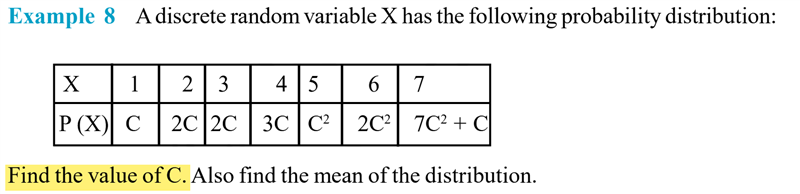
A random variable X has the following probability distribution:
| X | 1 | 2 | 3 | 4 | 5 | 6 | 7 |
| P(X) | C | 2C | 2C | 3C | C2 | 2C2 | 7C2+C |
Then the value of C is:
Answer & explanation
Correct answer: option 1
The correct answer is Option (1) → \(\displaystyle\frac{1}{10}\)
In a probability distribution the probabilities add up to 1:
\(C + 2C + 2C + 3C + C^2 + 2C^2 + 7C^2 + C = 1\)
\(10C^2 + 9C - 1 = 0\)
\((10C - 1)(C + 1) = 0\)
\( \displaystyle C = \frac{1}{10} \text{ or } C = -1 \)
A probability cannot be negative, and C = −1 would make P(X = 1) = −1. So \(C = \frac{1}{10}\).
Why the other options are incorrect
Option (2) \(\displaystyle\frac{1}{5}\) — Incorrect. \(10\left(\frac{1}{25}\right) + 9\left(\frac{1}{5}\right) = 0.4 + 1.8 = 2.2\), not 1.
Option (3) \(\displaystyle\frac{3}{10}\) — Incorrect. \(10\left(\frac{9}{100}\right) + 9\left(\frac{3}{10}\right) = 0.9 + 2.7 = 3.6\), not 1.
Option (4) −1 — Incorrect. It is a root of the quadratic, but it makes the probabilities negative, so it is rejected.
NCERT Exemplar:
Probability