What is the form of family found in Khasi Society?
(A) Patriarchal
(B) Matriarchal
(C) Matrilocal
(D) Matrilineal
(E) Patrilocal
Choose the correct answer from the options given below:
Answer & explanation
Correct answer: option 4
The correct answer is Option (4) → (D) Only
(A) Patriarchal Incorrect. A patriarchal family is one where men exercise authority and dominance. Khasi custom passes ancestral property in the female line, and a man’s power comes to him through his mother’s side, as the maternal uncle; the family is described as matrilineal, not patriarchal.
(B) Matriarchal Incorrect. Matriarchy would be a family where women exercise dominance. It has been a theoretical rather than an empirical concept; there is no historical or anthropological evidence of matriarchy. In matrilineal societies women inherit property but do not control it, nor are they the decision makers in public affairs.
(C) Matrilocal Incorrect. Matrilocal is a rule of residence: the newly married couple stays with the woman’s parents. The question asks for the form of family the Khasis are known for, and that is a rule of descent and inheritance, not of residence.
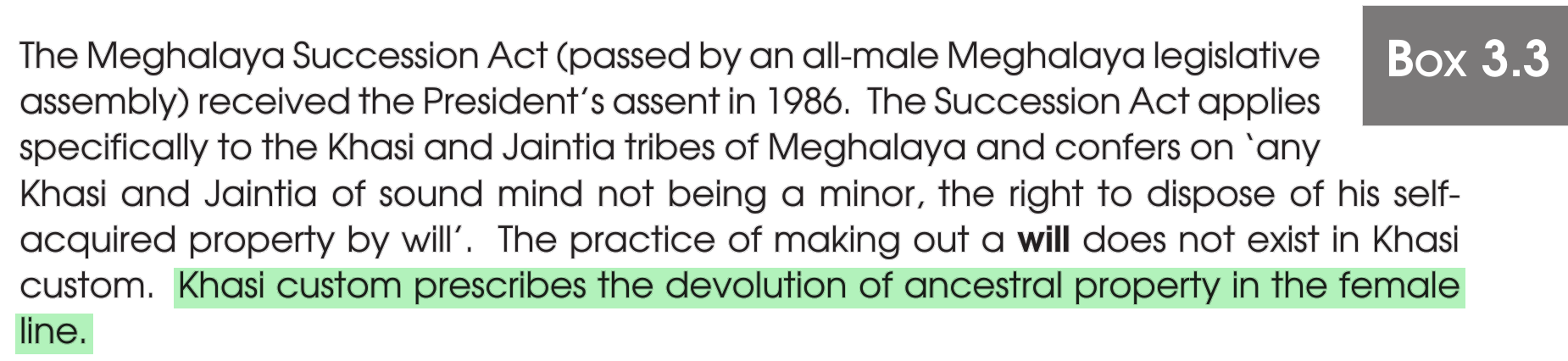
(D) Matrilineal Correct. Matrilineal societies pass on property from mother to daughter. The Khasis of Meghalaya are a matrilineal society: Khasi custom prescribes the devolution of ancestral property in the female line.
(E) Patrilocal Incorrect. Patrilocal means the couple lives with the man’s parents, again a rule of residence and the reverse of the female line that marks the Khasi family.
Note 1: NTA dropped this question in its final answer key. The original NTA paper printed Option (4) as ‘(C), (D), (E) Only’. As printed, every option joined Matrilineal (D) with at least one more item, and none gave Matrilineal alone, which is the form of family the NCERT book gives for the Khasis. Therefore, to leave a single correct answer, Option (4) has been changed to ‘(D) Only’, for the benefit of students.
Note 2: The box on Khasi matriliny in the chapter ‘Social Institutions: Continuity and Change’ was there in the pre-rationalised NCERT, which NTA followed in 2023. It has been deleted from the NCERT book (2025-26), though the chapter and its account of the diverse forms of the family are still there.
NCERT (2025-26): “3.3 Family and Kinship … Studies have shown how diverse family forms are found in different societies. With regard to the rule of residence, some societies are matrilocal in their marriage and family customs while others are patrilocal. In the first case, the newly married couple stays with the woman’s parents, whereas in the second case the couple lives with the man’s parents. With regard to the rules of inheritance, matrilineal societies pass on property from mother to daughter while patrilineal societies do so from father to son. A patriarchal family structure exists where the men exercise authority and dominance, and matriarchy where the women play a similarly dominant role. However, matriarchy – unlike patriarchy – has been a theoretical rather than an empirical concept. There is no historical or anthropological evidence of matriarchy – i.e., societies where women exercise dominance. However, there do exist matrilineal societies, i.e., societies where women inherit property from their mothers but do not exercise control over it, nor are they the decision makers in public affairs.” “5.3 Struggle for women’s equality and rights … But the strongest argument comes from the societies that were different from the ‘normal’ or common pattern. If women were biologically unfit to be inheritors and heads of families, how did matrilineal societies (as the Nairs of Kerala used to be, and as the Khasis of Meghalaya still are) work for centuries?…”
Box 3.3, Khasi matriliny (NCERT Pre-rationalised) |