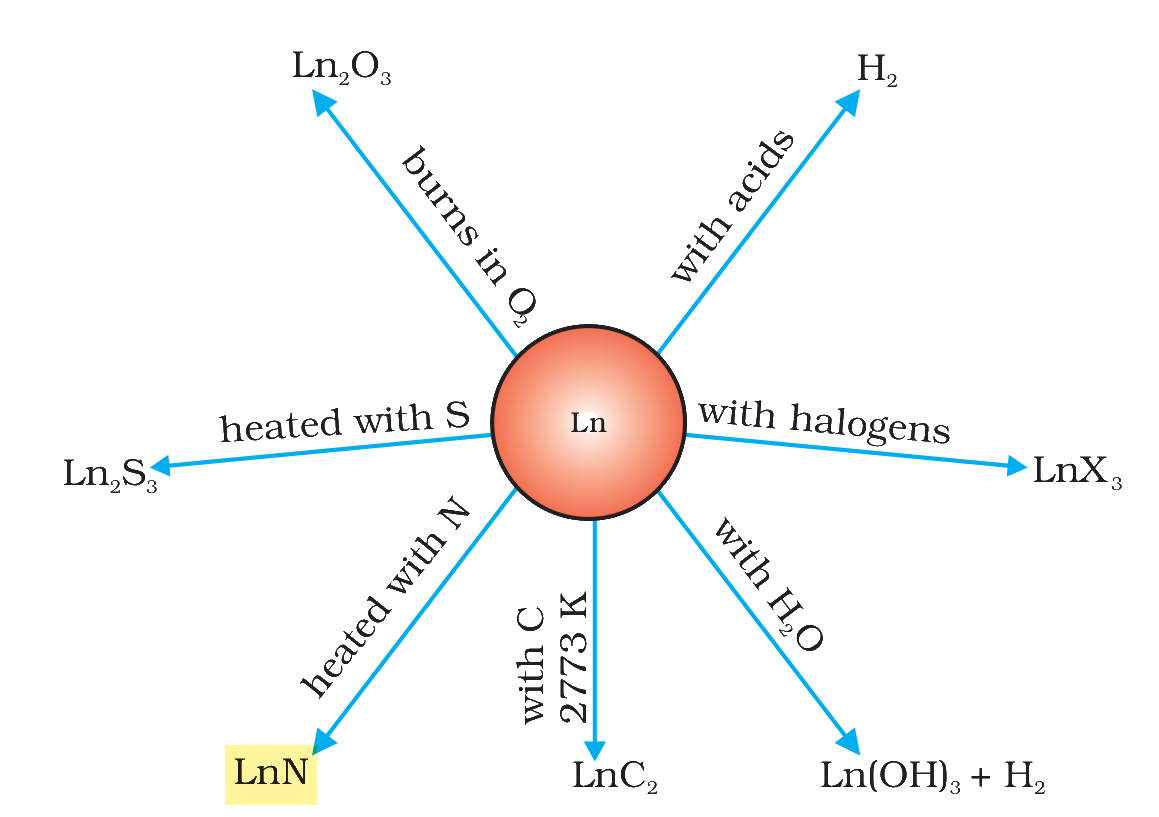
Lanthanoids (Ln) when heated with nitrogen, form compounds of the type _____.
Answer & explanation
Correct answer: option 3
The correct answer is Option (3) → \(LnN\)
The lanthanoids are reactive metals whose common oxidation state is +3. On heating they combine directly with many non-metals, and the formula of each product follows from the charge balance with \( \ce{Ln^3+} \). Nitrogen forms the nitride ion \( \ce{N^3-} \), so one Ln balances one N:
\( \displaystyle \ce{2Ln + N2} \xrightarrow{\Delta} \ce{2LnN} \)
So the nitrides are of the type LnN.
Why the other options are incorrect
Option (1) \(Ln_2N\) — Incorrect. With \( \ce{N^3-} \), two Ln atoms would each have to be +1.5: \( 2x = 3 \).
Option (2) \(LnN_2\) — Incorrect. Two nitride ions would need Ln in the +6 state, far above the lanthanoid range.
Option (4) \(Ln_2N_3\) — Incorrect. This would need \( 2x = 9 \), that is, Ln in the +4.5 state.
NCERT (2026-27 edition):
General Characteristics – “… In their chemical behaviour, in general, the earlier members of the series are quite reactive similar to calcium but, with increasing atomic number, they behave more like aluminium. … The metals combine with hydrogen when gently heated in the gas. The carbides, \( \ce{Ln3C} \), \( \ce{Ln2C3} \) and \( \ce{LnC2} \) are formed when the metals are heated with carbon. They liberate hydrogen from dilute acids and burn in halogens to form halides. They form oxides \( \ce{M2O3} \) and hydroxides \( \ce{M(OH)3} \). … Their general reactions are depicted in Fig. 4.7.”