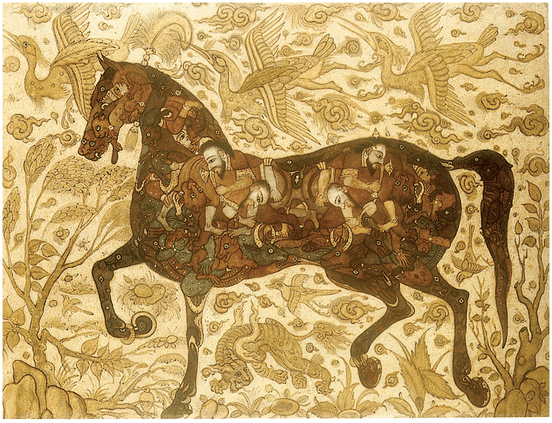
The Golconda painting Composite Horse has a strong surreal element. Which of the following enhance this surreal element?
Answer & explanation
Correct answer: option 1
The correct answer is Option (1) → Flying cranes and lions, Chinese clouds and large-leaved plants
Option (1) Flying cranes and lions, Chinese clouds and large-leaved plants — Correct. These enhance the surreal element of Composite Horse.
Option (2) Brilliant red limbs and tail of the horse, and the sultan’s flowing garment — Incorrect. These are in Sultan Ibrahim Adil Shah II hawking, where they render a visual experience which remains with one.
Option (3) Arabesque decoration on two domes and letters in Devanagari script — Incorrect. These are in Ragini Pathamsika of Raga Hindola, where the arabesque shows Persian influence.
Option (4) Dark dense forest foliage, cranes and a sunlit golden blue sky — Incorrect. These are in Sultan Ibrahim Adil Shah II hawking, where they enhance the experience of the painting and its narrative.
Note: This topic was not named in the CUET 2026 syllabus, but it was part of the NCERT chapter. In 2025 and 2026, NTA also asked questions on topics in NCERT that the CUET syllabus did not name. So our mocks have questions from every part of the NCERT chapter, to give you enough practice. Read the whole chapter, not only the sub-topics named in the syllabus.
NCERT (2026-27): “Composite Horse The painting is a curious mix of many artistic devices, which culminate as Composite Horse. The painting includes human figures intertwined in a manner that emerges as an extraordinary form of a galloping horse superimposed on a decorated background. Flying cranes and lions, Chinese clouds and plants with large leaves enhance the surreal element of this painting from Golconda, which is of early seventeenth century.”
|