CUETMOCK
  • Pricing
  • Mentors
Log inStart freeStart free mocks→

First test, then trust

Try a free CUET mock test.

Join 5,00,000+ students who rehearsed exam day on the exact NTA screen before sitting CUET. On the web and on Android.

Start free mocks →Get the Android app
CUETMOCK

India's #1 CUET Mock Test Platform. Original NCERT-based questions on the exact NTA exam screen — trusted by 5,00,000+ students since CUET 2022.

Get it onGoogle PlayScan to download the CUETMOCK app

Mock tests

  • CUET mock test series
  • Browse all papers
  • Commerce mocks
  • Humanities (Arts) mocks
  • Science mocks
  • Languages & GAT mocks
  • Free practice questions
  • Pricing

Resources

  • CUET exam guide
  • CUET syllabus
  • Universities accepting CUET
  • Expert blogs
  • News & notifications
  • Webinars & counselling
  • CUET score calculator
  • How we estimate your rank
  • FAQs

Company

  • About us
  • Our leadership & team
  • Our toppers
  • Mentors
  • For schools
  • Contact us
  • Terms
  • Privacy
  • Refund policy

Talk to us

+91 7696 6630 56info@cuetmock.comWhatsApp us

Our other platforms

  • JEE Mock — For IIT-JEE aspirants
  • NEET Mock — For NEET aspirants

Newsletter

Exam updates, study material and offers — no spam.

© 2026 NYC Ventures Pvt. Ltd.

701-702, Royal Business Park, Zirakpur, Punjab - 140603

  • Terms of use
  • Privacy policy
  • Refund policy
  • Contact us

iCUETMOCK is an independent preparation platform, not affiliated with the National Testing Agency (NTA). Always check exam details on the official NTA website.

  • Home
  • Mock tests
  • CUET guide
  • Pricing
  • Log in
Home/Practice questions/Sociology
SociologyIndian Society: Continuity and Change

Out of the following which custom is practiced in Khasi society? (A)…

Out of the following which custom is practiced in Khasi society?

(A) passing of property from mother to daughter

(B) transfer of control of property from maternal uncle to nephew

(C) making out a will

(D) brother controlling his sister's property

Choose the correct answer from the options given below:

Answer & explanation+

Correct answer: option 3

The correct answer is Option (3) → (A), (B) And (D) Only

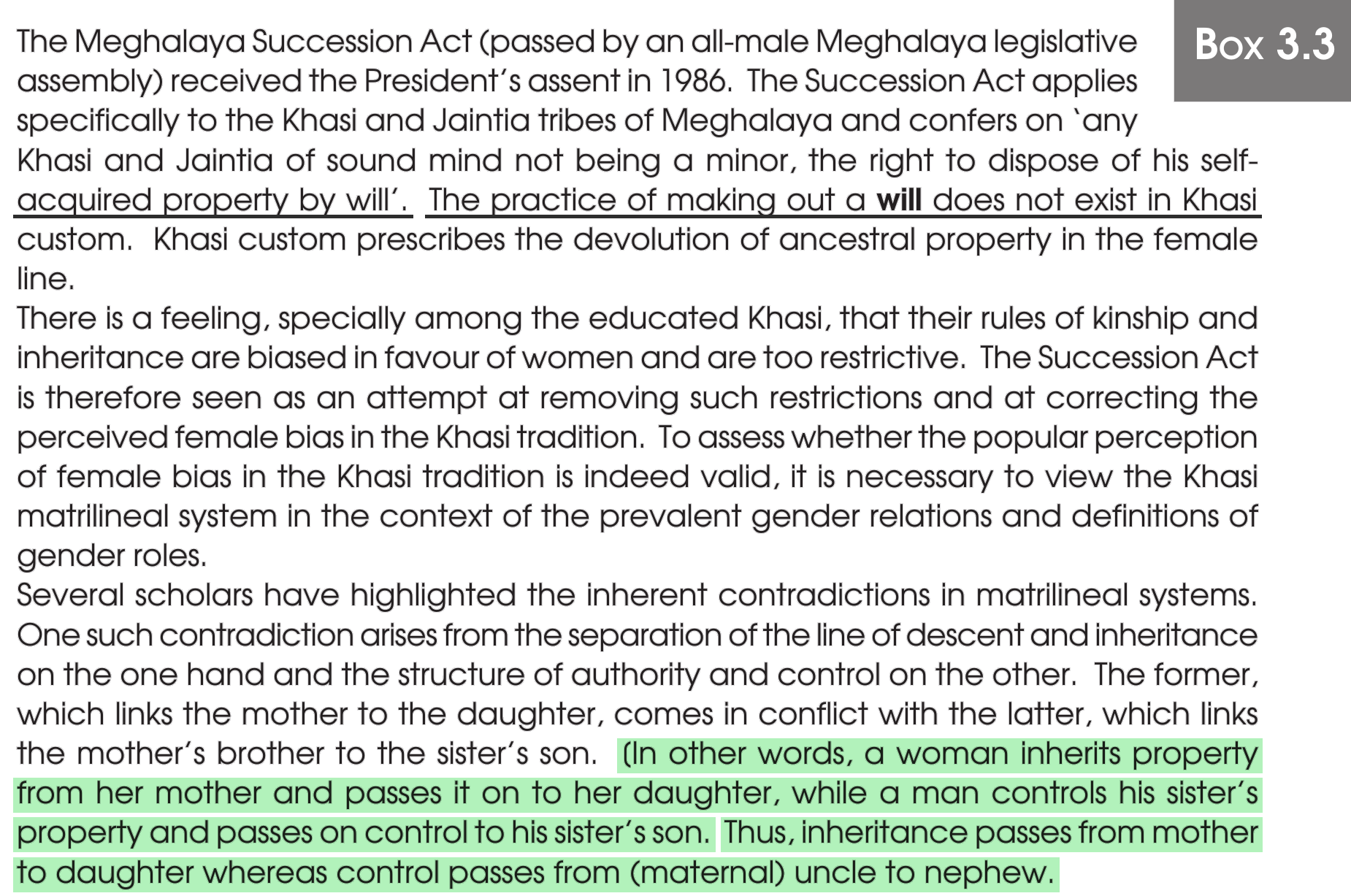
(A) passing of property from mother to daughter Correct. The Khasi are matrilineal: a woman inherits property from her mother and passes it on to her daughter, and Khasi custom prescribes the devolution of ancestral property in the female line.

(B) transfer of control of property from maternal uncle to nephew Correct. While inheritance runs from mother to daughter, control passes from the (maternal) uncle to the nephew, the sister’s son. This split between inheritance and control is the main contradiction of the Khasi system.

(C) making out a will Incorrect. The practice of making out a will does not exist in Khasi custom. The right to dispose of self-acquired property by will came only with the Meghalaya Succession Act of 1986, a law seen as an attempt at removing the restrictions of the custom, not a part of it.

(D) brother controlling his sister’s property Correct. A man controls his sister’s property and passes on that control to his sister’s son. Women possess only token authority; the men are the de facto power holders.

Note: Box 3.3 on the Khasi matrilineal family, in the chapter ‘Social Institutions: Continuity and Change’, was there in the pre-rationalised NCERT, which NTA followed in 2023. This box has been deleted from the NCERT book (2025-26), though the chapter and its section on matriliny and matriarchy are still there.


NCERT (2025-26): “3.3 F amily and K inship … With regard to the rules of inheritance, matrilineal societies pass on property from mother to daughter while patrilineal societies do so from father to son. A patriarchal family structure exists where the men exercise authority and dominance, and matriarchy where the women play a similarly dominant role. However, matriarchy – unlike patriarchy – has been a theoretical rather than an empirical concept. There is no historical or anthropological evidence of matriarchy – i.e., societies where women exercise dominance. However, there do exist matrilineal societies, i.e., societies where women inherit property from their mothers but do not exercise control over it, nor are they the decision makers in public affairs.”

NCERT extract

NCERT (Pre-rationalised): Box 3.3

Advertisement

Practise more on Indian Society: Continuity and Change

Chapter-wise mocks on the real NTA exam screen, with solutions and your rank. Your first mocks are free.

Start free mocks →

Advertisement

Next questions

  1. If x^4 +1/(x^4)= 16, then what is the value of x^2 +1/(x^2) ?General Aptitude Test · Quantitative Reasoning
  2. The National Rural Employment Programme was merged with _____ in 1989.General Aptitude Test · General Knowledge
  3. Which metal sulphate, composed of potassium, aluminium, and sulphate ions in the ratio 1 : 1 : 2, plays a role as a flame retardant, a mord…General Aptitude Test · General Knowledge
  4. In a class of 55 students, the number of students studying different subjects are, 23 in Mathematics, 24 in Physics, 19 in Chemistry, 12 in…Maths. Section B1 · Relations and Functions
  5. What will be the force experienced by charges in water if the force experienced by them in air is 320 N? The relative permeability of water…Physics · Electric Charges and Fields
  6. What is presumed to be the historical practice of women in the Mithila region regarding art?Fine Arts · The Living Art Traditions of India
  7. In the question given below, there are 2 statements marked as Assertion (A) and Reason (R). Choose the correct alternative from the followi…Economics · Indian Economic Development: Infrastructure
  8. Which of the following was introduced as a permanent member of G-20 in 2023 pursuant to the New Delhi Declaration in September 2023?General Aptitude Test · Current Affairs
  9. Which of the following is true about first stream of migration from India to the rest of the world?Geography · India-People and Economy: Migration Types, Causes and Consequences
  10. Match List I with List II. List I List II A. Systematic appraisal of the overall performance of the management I. PERT/CPM B. These techniq…Business Studies · Controlling