What do you understand by termolecular reactions
Answer & explanation
Correct answer: option 2
The correct answer is Option (2) → Three molecules colliding
The molecularity of an elementary reaction is the number of reacting species (atoms, ions or molecules) that must collide simultaneously for the reaction to occur. It is always a whole number:
Unimolecular: one species decomposes, \( \ce{NH4NO2 -> N2 + 2H2O} \).
Bimolecular: two species collide, \( \ce{2HI -> H2 + I2} \).
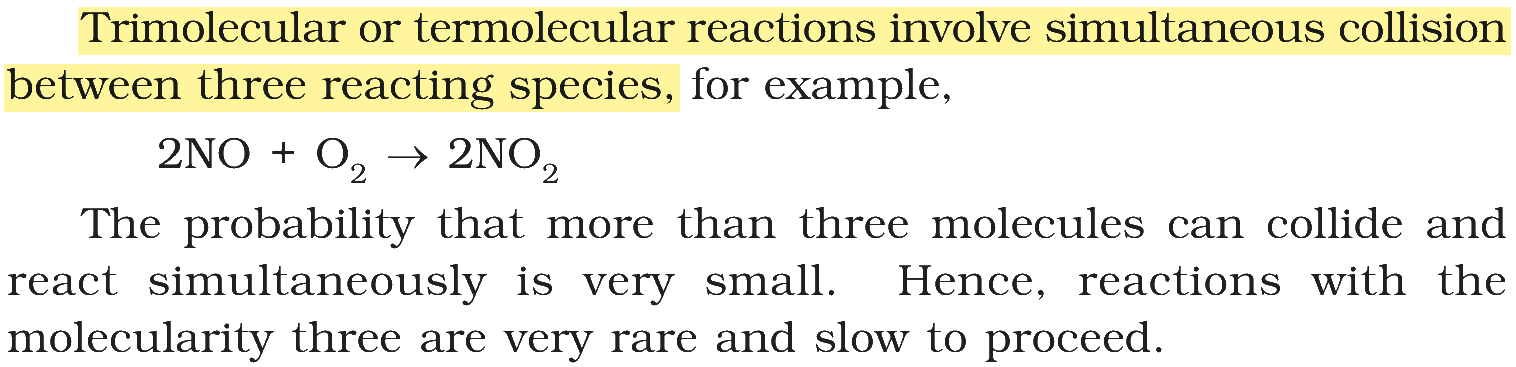
Trimolecular or termolecular: three species collide at the same time, \( \ce{2NO + O2 -> 2NO2} \).
So a termolecular reaction involves three molecules colliding at once. Such collisions are rare, so termolecular reactions are few and slow.
Why the other options are incorrect
Option (1) One molecule dissociating — Incorrect. This describes a unimolecular reaction, such as the decomposition of ammonium nitrite.
Option (3) Two molecules colliding — Incorrect. This describes a bimolecular reaction, such as the decomposition of HI.
Option (4) Four molecules colliding — Incorrect. The chance of more than three molecules colliding at the same instant is very small, so elementary reactions with molecularity four are not observed; reactions whose equations show more molecules go through several steps.
NCERT (2026-27 edition):
Molecularity of a Reaction – …