
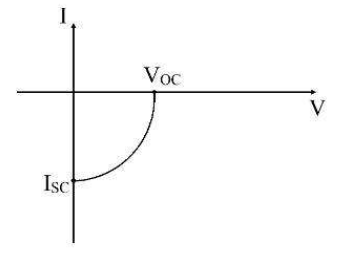
I-V characteristics of solar cell is drawn in the fourth quadrant. The reason is
Answer & explanation
Correct answer: option 1
The correct answer is Option (1) → Solar cell does not draw current and supplies the same to the load.
A solar cell is a p-n junction that produces an emf when light falls on it; no external battery is connected. It develops a photo-voltage (positive \( V \)) and drives a photocurrent through the load that is opposite to the forward current of a diode (negative \( I \)). Positive \( V \) with negative \( I \) puts the curve in the fourth quadrant.
Option (1) Solar cell does not draw current and supplies the same to the load. — Correct. The cell is a source: it draws no current from outside and supplies current to the load.
Option (2) Solar cell draws the current and does not supply. — Incorrect. A device that draws current from outside (like a forward-biased diode) has its curve in the first quadrant.
Option (3) Solar cell does not supply the current. — Incorrect. Supplying current to the load is the whole purpose of a solar cell.
Option (4) Solar cell only stores the light energy. — Incorrect. A solar cell converts light energy into electrical energy as the light falls; it does not store energy.
Note: This question is from the pre-rationalised NCERT book (2022-23). The topic was removed from the latest NCERT book (2026-27), and it also appears to be out of the CUET 2026 syllabus.
NCERT (Pre-rationalised edition, 2022-23):
Solar Cell – “… A typical I-V characteristics of a solar cell is shown in the Fig. 14.25(b). Note that the I – V characteristics of solar cell is drawn in the fourth quadrant of the coordinate axes. This is because a solar cell does not draw current but supplies the same to the load.”