
The figure shows the arrangement used for measuring the resistance of a solution of an electrolyte.
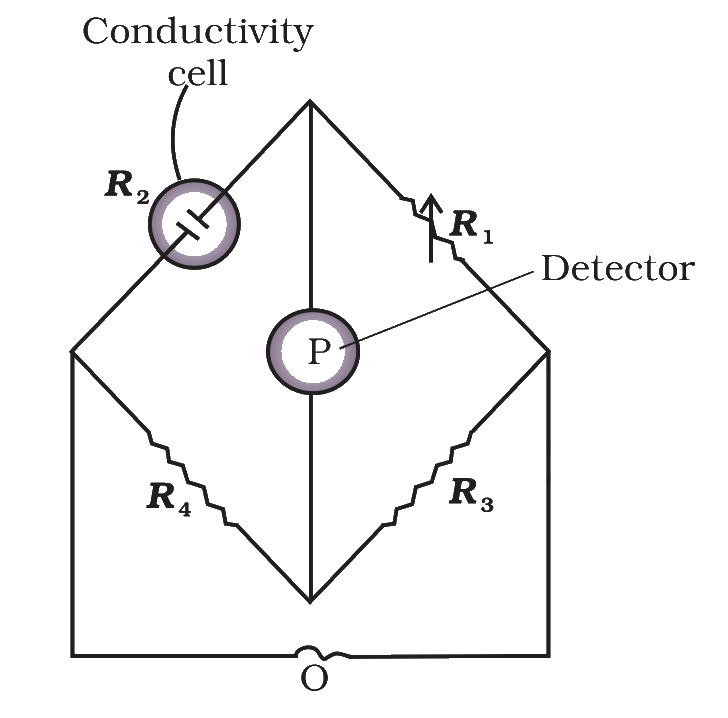
When the bridge is balanced (no current passes through the detector P), the unknown resistance R2 of the conductivity cell is given by:
Answer & explanation
Correct answer: option 1
The correct answer is Option (1) → R2 = R1R4/R3
The arrangement is a Wheatstone bridge. The oscillator O feeds it at the left and right corners, and the detector P joins the top and bottom corners. One path runs through R2 (the conductivity cell) and R1, the other through R4 and R3. When no current passes through P, the top and bottom corners are at the same potential, so the resistances on the two paths are in the same ratio:
R2/R1 = R4/R3, so R2 = R1R4/R3
NCERT (2026-27 edition):
2.4.1 Measurement of the Conductivity of Ionic Solutions – “…The set up for the measurement of the resistance is shown in Fig. 2.5.”
“It consists of two resistances R3 and R4, a variable resistance R1 and the conductivity cell having the unknown resistance R2. The Wheatstone bridge is fed by an oscillator O (a source of a.c. power in the audio frequency range 550 to 5000 cycles per second). P is a suitable detector (a headphone or other electronic device) and the bridge is balanced when no current passes through the detector. Under these conditions:”
Unknown resistance R2 = R1R4/R3 (2.19)
Fig. 2.5: Arrangement for measurement of resistance of a solution of an electrolyte.