
CUETMOCK
  • Pricing
  • Mentors
Log inStart freeStart free mocks→

First test, then trust

Try a free CUET mock test.

Join 5,00,000+ students who rehearsed exam day on the exact NTA screen before sitting CUET. On the web and on Android.

Start free mocks →Get the Android app
CUETMOCK

India's #1 CUET Mock Test Platform. Original NCERT-based questions on the exact NTA exam screen — trusted by 5,00,000+ students since CUET 2022.

Get it onGoogle PlayScan to download the CUETMOCK app

Mock tests

  • CUET mock test series
  • Commerce mocks
  • Humanities (Arts) mocks
  • Science mocks
  • Languages & GAT mocks
  • Free practice questions
  • Pricing

Resources

  • CUET exam guide
  • CUET syllabus
  • Universities accepting CUET
  • Expert blogs
  • News & notifications
  • Webinars & counselling
  • CUET score calculator
  • How we estimate your rank
  • FAQs

Company

  • About us
  • Our leadership & team
  • Our toppers
  • Mentors
  • For schools
  • Contact us
  • Terms
  • Privacy
  • Refund policy

Talk to us

+91 7696 6630 56info@cuetmock.comWhatsApp us

Our other platforms

  • JEE Mock — For IIT-JEE aspirants
  • NEET Mock — For NEET aspirants

Newsletter

Exam updates, study material and offers — no spam.

© 2026 NYC Ventures Pvt. Ltd.

701-702, Royal Business Park, Zirakpur, Punjab - 140603

  • Terms of use
  • Privacy policy
  • Refund policy
  • Contact us

iCUETMOCK is an independent preparation platform, not affiliated with the National Testing Agency (NTA). Always check exam details on the official NTA website.

  • Home
  • Mock tests
  • CUET guide
  • Pricing
  • Log in
Home/Practice questions/Chemistry
ChemistryOrganic: Aldehydes, Ketones and Carboxylic Acids

The figure shows the orbital diagram for the formation of the carbony…

The figure shows the orbital diagram for the formation of the carbonyl group.
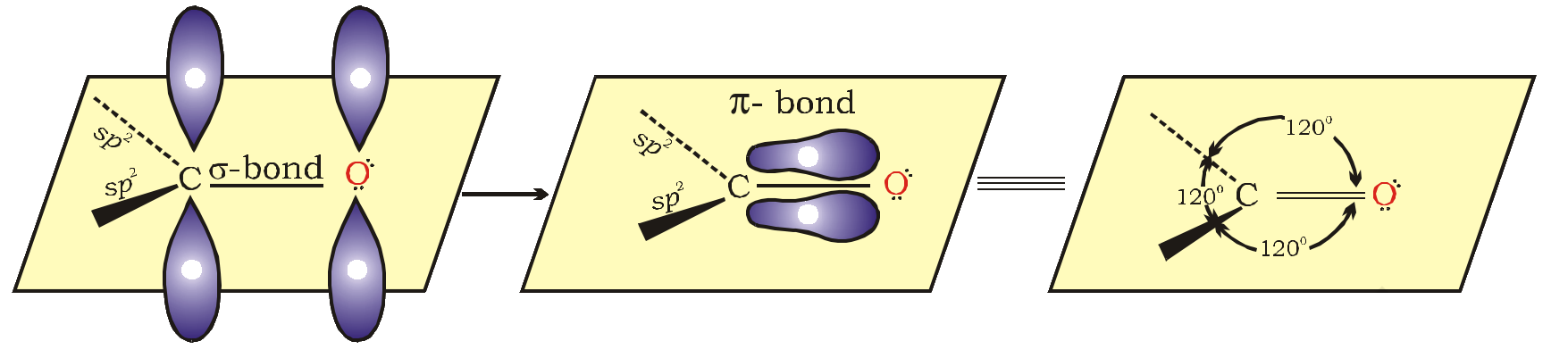
Fig. 8.1 Orbital diagram for the formation of carbonyl group

Which of the following correctly describes the π bond of the carbonyl group shown in the figure?

Answer & explanation+

Correct answer: option 3

The correct answer is Option (3) → It is formed by overlap of a p orbital of carbon with a p orbital of oxygen, and its electron cloud lies above and below the plane of the sp2 orbitals.

In the first panel the carbon uses its three sp2 orbitals in the plane: two are labelled sp2 and the third forms the C–O σ bond. The upright lobes standing above and below the plane on C and on O are the unhybridised p orbitals.

  • Orbitals that overlap — a p orbital of C and a p orbital of O. In the second panel these two upright p orbitals overlap sideways to give the π bond. The sp2 orbitals of carbon stay in the plane and are used only for σ bonds.

  • Position of the π-electron cloud — above and below the plane. The π bond is drawn as two lobes, one above and one below the plane. The region along the C–O axis, in the plane, is taken by the σ bond.

Why the other options are incorrect

Option (1) It is formed by overlap of an sp2 orbital of carbon with a p orbital of oxygen, and its electron cloud lies above and below the plane of the sp2 orbitals. — Incorrect. The position of the cloud is right, but an sp2 orbital of carbon forms a σ bond, not the π bond.

Option (2) It is formed by overlap of a p orbital of carbon with a p orbital of oxygen, and its electron cloud lies in the plane of the sp2 orbitals, along the C–O axis. — Incorrect. The orbitals are right, but a cloud along the C–O axis in the plane describes the σ bond.

Option (4) It is formed by overlap of an sp2 orbital of carbon with a p orbital of oxygen, and its electron cloud lies in the plane of the sp2 orbitals, along the C–O axis. — Incorrect. Both parts are wrong: this describes a σ bond formed from an sp2 orbital.

NCERT (2026-27 edition):
8.1.2 Structure of the Carbonyl Group – “The carbonyl carbon atom is sp2-hybridised and forms three sigma (σ) bonds. The fourth valence electron of carbon remains in its p-orbital and forms a π-bond with oxygen by overlap with p-orbital of an oxygen. In addition, the oxygen atom also has two non bonding electron pairs. Thus, the carbonyl carbon and the three atoms attached to it lie in the same plane and the π-electron cloud is above and below this plane. The bond angles are approximately 120° as expected of a trigonal coplanar structure (Figure 8.1).”

Fig. 8.1

Fig. 8.1: Orbital diagram for the formation of carbonyl group

Advertisement

Practise more on Organic: Aldehydes, Ketones and Carboxylic Acids

Chapter-wise mocks on the real NTA exam screen, with solutions and your rank. Your first mocks are free.

Start free mocks →

Advertisement

Next questions

  1. In a certain code language, 'SNOW' is coded as '21, 16, 17, 25', 'RIDE' is coded as '20, 11, 6, 7'. What is the code for 'TAPE' in that cod…General Aptitude Test · Verbal Reasoning
  2. In a star network, how many lines are required for connecting N nodes to the host node?General Aptitude Test · General Knowledge
  3. Formic acid does not respond toChemistry · Organic: Aldehydes, Ketones and Carboxylic Acids
  4. If f(sin x) - f(-sin x) = x^2-1 is defined for all real x, then the value of x^2 - 2 can be ____.Maths. Section B1 · Relations and Functions
  5. Match the phrases given in List-I with the most appropriate words given in List-II.List-I (Phrases)List-II (Words)(A) A doctor who treats t…English · One Word
  6. An exterior angle of a regular polygon is 24°. How many sides will the polygon have?General Aptitude Test · Quantitative Reasoning
  7. Assertion: Diaphragms, cervical caps and vaults are barrier made made of rubber that are inserted into the female reproductive tract to cov…Biology · Reproductive Health
  8. The Table given below presents the profit (in multiple of thousand rupees) of a firm for the years 2010-2018. By how much percentage is the…General Aptitude Test · Quantitative Reasoning
  9. Who among the following musicians has won the Bharat Ratna Award?General Aptitude Test · General Knowledge
  10. Who is known as "The Father of Green Revolution" in the world?General Aptitude Test · General Knowledge