
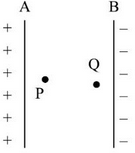
Two protons P and Q are placed between two charged plates A and B as shown, then
Answer & explanation
Correct answer: option 3
The correct answer is Option (3) → Both experiences same force towards right hand side
Between two large oppositely charged parallel plates the electric field is uniform: it has the same magnitude everywhere and points from the positive plate to the negative plate. Plate A is positive and plate B is negative, so the field points to the right.
The force on a proton is \( \vec{F} = e\vec{E} \), along the field.
Option (1) P experiences more force as closer to positive charged plate — Incorrect. The field is uniform, so the force does not depend on the distance from either plate.
Option (2) Q experiences more force as closer to negative charged plate — Incorrect. For the same reason Q feels the same force as P, whatever its position between the plates.
Option (3) Both experiences same force towards right hand side — Correct. Both protons carry the same charge in the same uniform field, so both feel the same force, \( eE \), towards the right.
Option (4) Both experience same force towards left hand side — Incorrect. A positive charge is pushed along the field, to the right.
NCERT (2026-27):
The Parallel Plate Capacitor – “… In the inner region between the plates 1 and 2, the electric fields due to the two charged plates add up, giving
\( \displaystyle E = \frac{\sigma}{2\varepsilon_0} + \frac{\sigma}{2\varepsilon_0} = \frac{\sigma}{\varepsilon_0} = \frac{Q}{\varepsilon_0 A} \qquad (2.41) \)
The direction of electric field is from the positive to the negative plate. Thus, the electric field is localised between the two plates and is uniform throughout.”