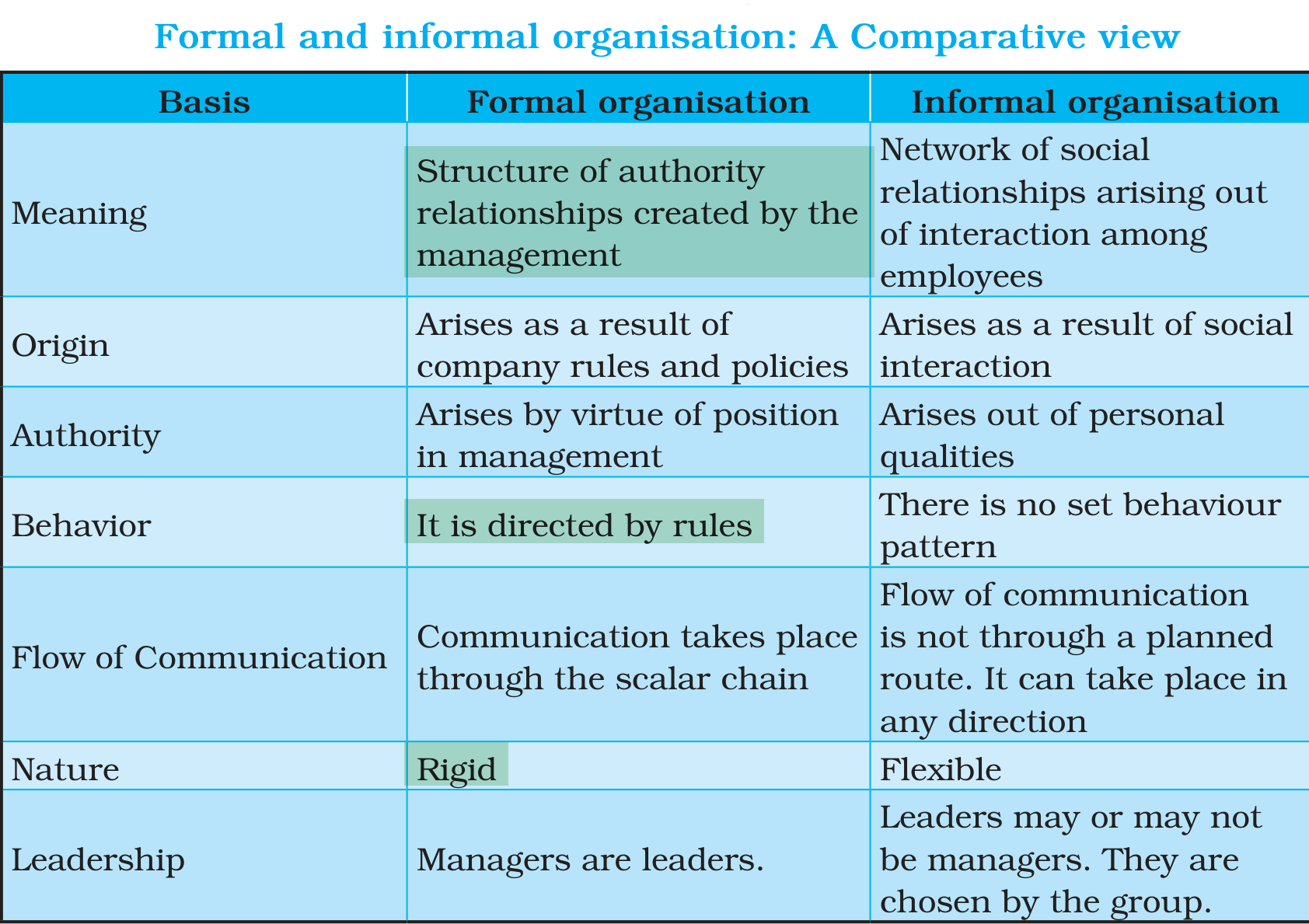
Which of the following statements represent formal organisation?
(A) MCS Limited has a structure of authority relationships that was carefully planned and created by its top management.
(B) Some employees of MCS Limited have formed a group that plays cricket every Sunday.
(C) In a group of employees, the standards of behaviour evolve from group norms rather than official rules.
(D) At ABC Limited, the behaviour of employees is directed by rules, and the organisation is rigid in nature.
Choose the correct answer from the options given below:
Answer & explanation
Correct answer: option 3
The correct answer is Option (3) → (A) and (D) only
(A) MCS Limited has a structure of authority relationships that was carefully planned and created by its top management. — True. The structure at MCS Limited was planned and created by its top management, and a structure designed by the management is formal organisation, so (A) shows formal organisation.
(B) Some employees of MCS Limited have formed a group that plays cricket every Sunday. — False. A Sunday cricket group forms from friendship and common interest among employees, not from the management’s design, so it is an informal group and not formal organisation.
(C) In a group of employees, the standards of behaviour evolve from group norms rather than official rules. — False. Standards of behaviour that evolve from group norms instead of officially laid down rules mark informal organisation, so this group is not formal organisation.
(D) At ABC Limited, the behaviour of employees is directed by rules, and the organisation is rigid in nature. — True. In formal organisation behaviour is directed by rules and the nature is rigid, because it arises from company rules and policies; ABC Limited shows both, so it is formal organisation.
NCERT Extract (2026-27 Edition): Correct statements (A) and (D) Formal and Informal Organisation: “Formal organisation refers to the organisation structure which is designed by the management to accomplish a particular task.”
Incorrect statements (B) and (C) Informal Organisation: “Examples of such groups formed with common interest may be those who take part in cricket matches on Sundays, meet in the cafeteria for coffee, are interested in dramatics, etc.” “The standards of behaviour evolve from group norms rather than officially laid down rules and regulations.” |