
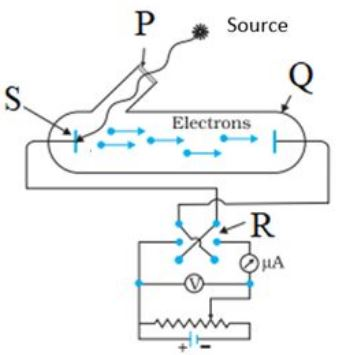
In the experimental arrangement for study of photoelectric effect given below, P, Q, R and S, respectively are
(A) Commutator
(B) Evacuated Glass Tube
(C) Photosensitive Plate
(D) Quartz Window
Choose the correct answer from the options given below:
Answer & explanation
Correct answer: option 2
The correct answer is Option (2) → (D), (B), (A), (C)
In the photoelectric set-up, light enters an evacuated tube through a quartz window (quartz lets ultraviolet light through), falls on the emitter plate and ejects electrons, which travel to the collector. A commutator (reversing key) lets the collector be made positive or negative with respect to the emitter.
P — the window through which the light from the source enters: (D) Quartz Window.
Q — the tube that holds the two electrodes: (B) Evacuated Glass Tube.
R — the switch with crossed connections in the external circuit, which reverses the polarity: (A) Commutator.
S — the plate on which the light falls and from which the electrons leave: (C) Photosensitive Plate.
So P, Q, R and S are (D), (B), (A), (C).
NCERT (2026-27):
Experimental Study of Photoelectric Effect – “… It consists of an evacuated glass/quartz tube having a thin photosensitive plate C and another metal plate A. … A transparent quartz window is sealed on to the glass tube, which permits ultraviolet radiation to pass through it and irradiate the photosensitive plate C. … The polarity of the plates C and A can be reversed by a commutator.”