Read the Passage carefully and answer the questions.
Microbes in human welfare
Microbes are a very important component of life on earth. We use microbes and microbially derived products almost every day, like LAB to make curd, yeast to make bread, adding flavor and texture to cheese, producing antibiotics etc. The addition of LAB, improves the milk quality by increasing vit. B12. Cheese is one of the oldest food items in which microbes are used. For example, large holes in Swiss cheese are due to CO2 produced by the bacterium Propionibacterium sharmanii. The BOD test measures the rate of uptake of oxygen by microorganisms in a sample of water and thus, indirectly, BOD is a measure of the organic matter present in the water. The greater the BOD of waste water, the more is its polluting potential. In anaerobic sludge digesters, bacteria produce a mixture of gases like methane, hydrogen sulphide and carbon dioxide. These gases form biogas and can be used as a source of energy. Biofertilisers are organisms that enrich the nutrient quality of the soil. The main sources of biofertilisers are bacteria, fungi and cyanobacteria. You have studied about the nodules on the roots of leguminous plants formed by the symbiotic association of Rhizobium. These bacteria fix atmospheric nitrogen into organic forms, which is used by the plant as a nutrient. Other bacteria can fix atmospheric nitrogen while free-living in the soil (examples Azospirillum and Azotobacter).
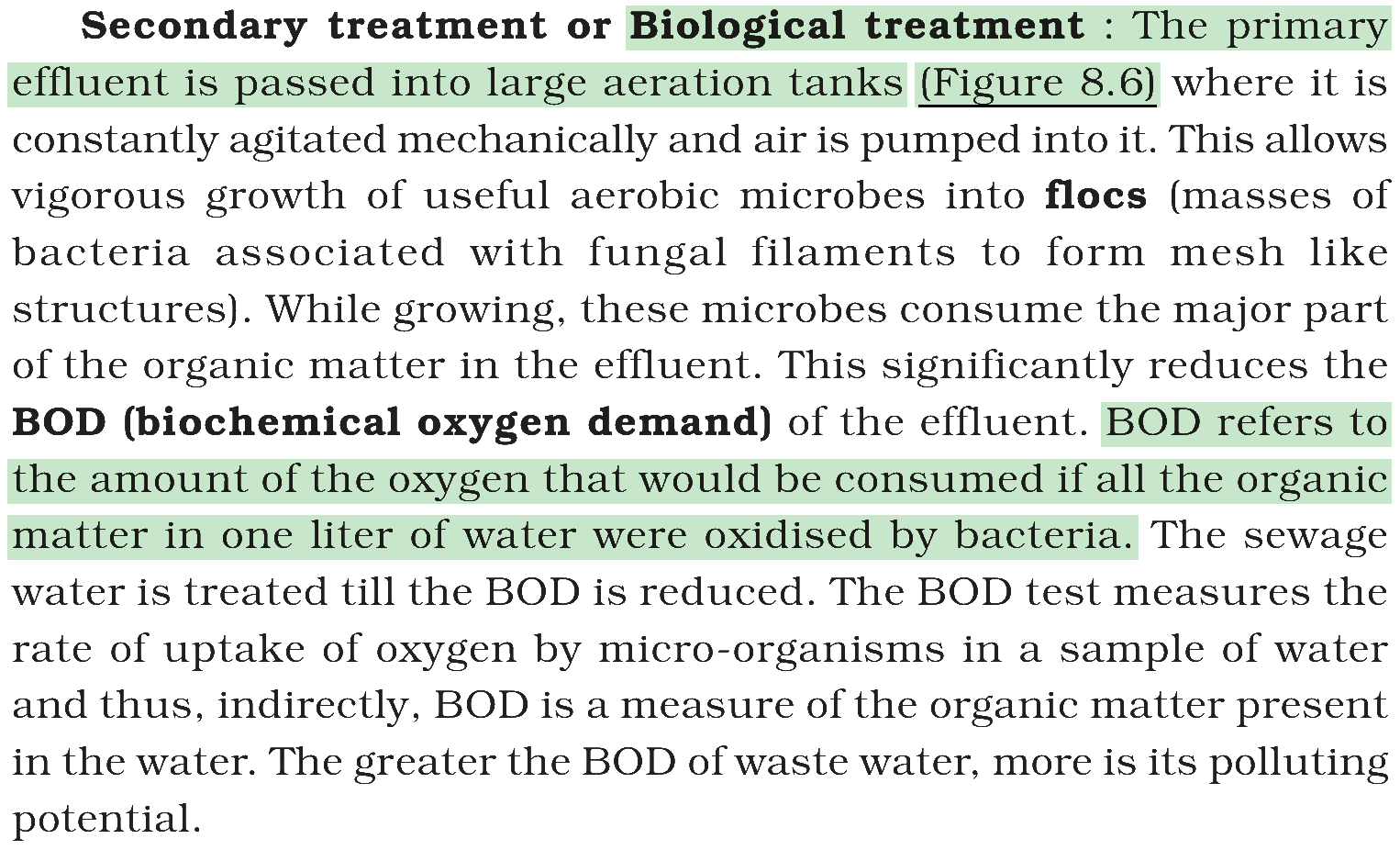
BOD refers to the -
Answer & explanation
Correct answer: option 4
The correct answer is Option (4) → Amount of the oxygen that would be consumed if all the organic matter in one liter of water were oxidised by bacteria.
BOD stands for biochemical oxygen demand. Aerobic bacteria break down organic matter by oxidising it, and for this they take in oxygen from the water.
Option (1) Amount of the oxygen that would be released if all the organic matter in one liter of water were reduced by bacteria. — Incorrect. Both words are reversed. Bacteria oxidise the organic matter, they do not reduce it. And the oxygen is used up, not given out.
Option (2) Amount of the oxygen that would be consumed if all the organic matter in one liter of water were reduced by bacteria. — Incorrect. “Consumed” is right, but the process is wrong. Breaking down organic matter with oxygen is oxidation, not reduction.
Option (3) Amount of the oxygen that would be released if all the organic matter in one liter of water were oxidised by bacteria. — Incorrect. “Oxidised” is right, but oxidation by bacteria uses oxygen; it does not release it. That is why water with a high BOD loses its dissolved oxygen.
Option (4) Amount of the oxygen that would be consumed if all the organic matter in one liter of water were oxidised by bacteria. — Correct. Both parts fit: the bacteria oxidise the organic matter and consume oxygen while doing it.
Note: The passage is taken from NCERT. NTA has put lines of the NCERT text together to make it. Most CUET (UG) questions come straight from NCERT, so study the book line by line, including figures and their titles.
NCERT Extract:
Microbes in Sewage Treatment – …