CUETMOCK
  • Pricing
  • Mentors
Log inStart freeStart free mocks→

First test, then trust

Try a free CUET mock test.

Join 5,00,000+ students who rehearsed exam day on the exact NTA screen before sitting CUET. On the web and on Android.

Start free mocks →Get the Android app
CUETMOCK

India's #1 CUET Mock Test Platform. Original NCERT-based questions on the exact NTA exam screen — trusted by 5,00,000+ students since CUET 2022.

Get it onGoogle PlayScan to download the CUETMOCK app

Mock tests

  • CUET mock test series
  • Browse all papers
  • Commerce mocks
  • Humanities (Arts) mocks
  • Science mocks
  • Languages & GAT mocks
  • Free practice questions
  • Pricing

Resources

  • CUET exam guide
  • CUET syllabus
  • Universities accepting CUET
  • Expert blogs
  • News & notifications
  • Webinars & counselling
  • CUET score calculator
  • How we estimate your rank
  • FAQs

Company

  • About us
  • Our leadership & team
  • Our toppers
  • Mentors
  • For schools
  • Contact us
  • Terms
  • Privacy
  • Refund policy

Talk to us

+91 7696 6630 56info@cuetmock.comWhatsApp us

Our other platforms

  • JEE Mock — For IIT-JEE aspirants
  • NEET Mock — For NEET aspirants

Newsletter

Exam updates, study material and offers — no spam.

© 2026 NYC Ventures Pvt. Ltd.

701-702, Royal Business Park, Zirakpur, Punjab - 140603

  • Terms of use
  • Privacy policy
  • Refund policy
  • Contact us

iCUETMOCK is an independent preparation platform, not affiliated with the National Testing Agency (NTA). Always check exam details on the official NTA website.

  • Home
  • Mock tests
  • CUET guide
  • Pricing
  • Log in
Home/Practice questions/Political Science
Political ScienceContemporary World Politics: The Cold War Era

In the context of the Cold War, arrange the following events in chron…

In the context of the Cold War, arrange the following events in chronological order.
 
A. Gorbachev became the President of the USSR
B. Formation of North Atlantic Treaty Organisation
C. Placement of Nuclear Missiles in Cuba
D. The first summit of the Non-Alignment Movement
E. Formation of Eastern Alliance
 
Choose the correct answer from the options given below:
Answer & explanation+

Correct answer: option 3

The correct answer is Option (3) → B, E, D, C, A

B. Formation of North Atlantic Treaty Organisation — April 1949.

E. Formation of Eastern Alliance — the Warsaw Pact, 1955.

D. The first summit of the Non-Alignment Movement — held in Belgrade in September 1961.

C. Placement of Nuclear Missiles in Cuba — the Cuban Missile Crisis of 1962; China invaded India in October 1962 while the world’s attention was on this crisis.

A. Gorbachev became the President of the USSR — 1985.

Note 1: The dates of the formation of NATO (1949) and of the Warsaw Pact (1955) are taken from the chapter ‘The Cold War Era’, which was there in the pre-rationalised NCERT and has been deleted from subsequent editions of NCERT, including the NCERT book (2026-27). The other three events are in the NCERT book (2026-27) as well.

Note 2: The Cold War timeline of the pre-rationalised NCERT gives 1985 as the year in which Gorbachev became the President of the USSR. The chapter ‘The End of Bipolarity’ (in the pre-rationalised book and in the later editions, 2023-24, 2025-26 and 2026-27) says that he had become General Secretary of the Communist Party of the Soviet Union in 1985. Either way, it is the last of the five events.


NCERT (2026-27): “Afro-Asian unity … The Bandung Conference later led to the establishment of the NAM. The First Summit of the NAM was held in Belgrade in September 1961.…

The Chinese invasion, 1962 … Around this time, while the entire world’s attention was on the Cuban Missile crisis involving the two superpowers, China launched a swift and massive invasion in October 1962 on both the disputed regions.…”

NCERT (2026-27), chapter ‘The End of Bipolarity’: “Gorbachev and the Disintegration Mikhail Gorbachev, who had become General Secretary of the Communist Party of the Soviet Union in 1985, sought to reform this system.…”

NCERT (Pre-rationalised), chapter ‘The Cold War Era’: “The Emergence of Two Power Blocs … The western alliance was formalised into an organisation, the North Atlantic Treaty Organisation (NATO), which came into existence in April 1949. It was an association of twelve states which declared that armed attack on any one of them in Europe or North America would be regarded as an attack on all of them. Each of these states would be obliged to help the other. The eastern alliance, known as the Warsaw Pact, was led by the Soviet Union. It was created in 1955 and its principal function was to counter NATO’s forces in Europe.…

Challenge to Bipolarity … These five leaders came to be known as the five founders of NAM. The first non-aligned summit was held in Belgrade in 1961.…”

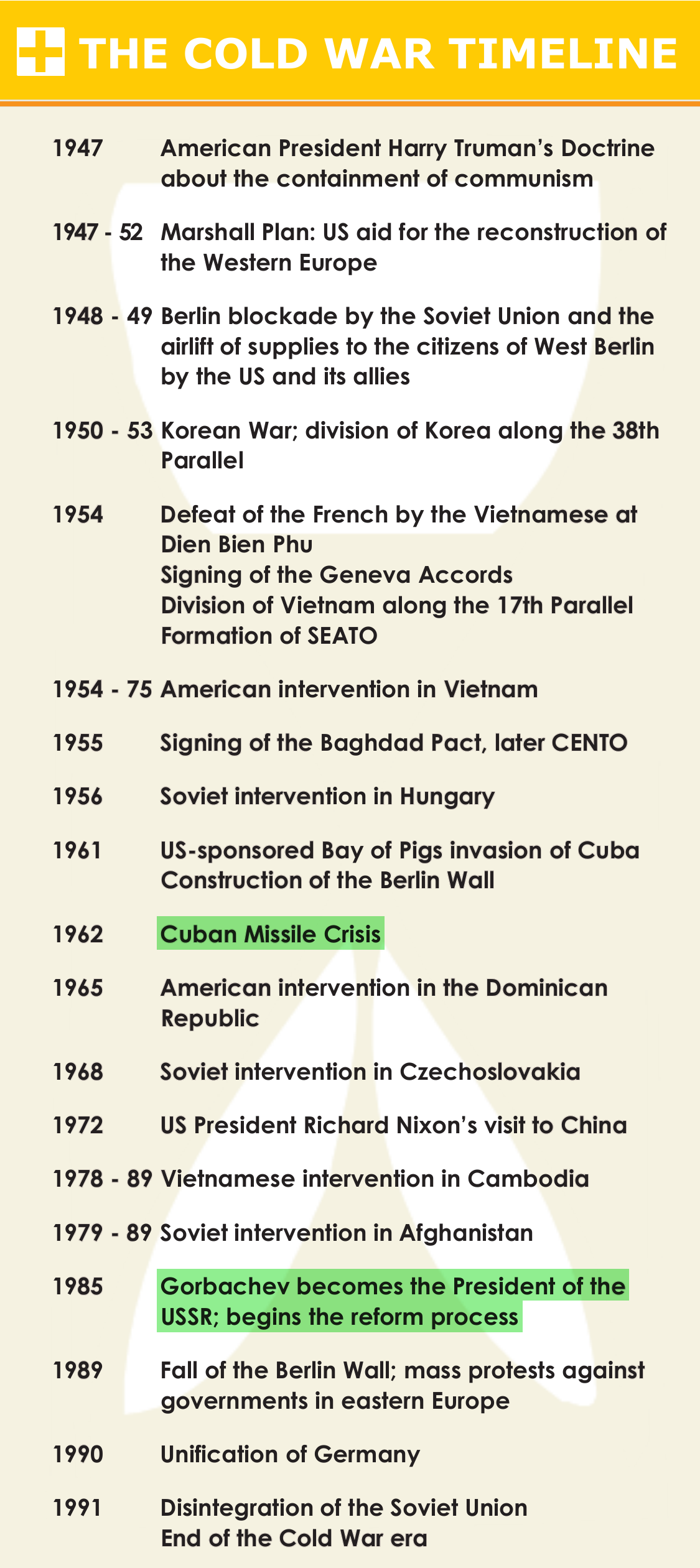
NCERT (Pre-rationalised): The Cold War timeline, chapter ‘The Cold War Era’

NCERT extract

Advertisement

Practise more on Contemporary World Politics: The Cold War Era

Chapter-wise mocks on the real NTA exam screen, with solutions and your rank. Your first mocks are free.

Start free mocks →

Advertisement

Next questions

  1. The average weight of A, B and C is 55 kg. The weight of C is 10 kg more than A and 5 kg more than B. The average weight of A, B, C and D,…General Aptitude Test · Numerical Ability
  2. Which of the following is NOT a part of Dhamma of the King Ashoka?History · Ancient India: Kings, Farmers and Towns
  3. Which of the following statements is correct in relation to economic development? a- The economic development of a region depends upon its…Geography · India-People and Economy: Planning and Sustainable development in Indian Context
  4. Match List – I with List – II. List - I List - II (Avg Period) (A) Amount withdrawn at the beginning of each month (I) 5.5 months (B) Amoun…Accountancy Part A · Accounting for Partnership
  5. This model allowed China to use its resources to establish the foundations of an industrial economy on a scale that did not exist before. E…Political Science · Contemporary World Politics: Contemporary Centres of power
  6. In which year was the state of Punjab for the Punjabi speaking population formed?Political Science · Politics in India Since Independence: Regional Aspirations
  7. Capital Receipt is the receipt of Government which.A. Decreases Liabilities of GovernmentB. Increases Liabilities of GovernmentC. Increases…Economics · Macro Economics: Government Budget and Economy
  8. Choose the word that does not belong to the group.English · Odd One Out
  9. Match List I with List II List I - LeaderList II - Description/Associated with(A)Ram Manohar Lohia(I)Advocacy of reservation for backward c…Political Science · Politics in India Since Independence: Challenges to and Restoration of the Congress System
  10. Select the most appropriate meaning of the following idiom. To take a back seatEnglish · Grammar: Idioms