
P and Q can do a piece of work in 14 days. Q and R together can do it in 21 days. If P is twice as good a workman as R, then in how many days Q alone can do the work?
Answer & explanation
Correct answer: option 1
P + Q = 14 days,
Q + R = 21 days,
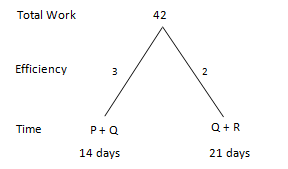
As Given,
P is twice efficient than R, therefore
⇒ P : R = 2 : 1 (Efficiency)
⇒ P + Q = 3, Q + R = 2,
Solving the efficiencies we get all the efficiencies, i.e;
P = 2, Q = 1, R = 1,
⇒ Time taken by Q to complete total work alone = \(\frac{42}{1}\) = 42 days. ..(\(\frac{Work}{Efficiency}\) = Time )