
Nucleic acids are mainly of two types: deoxyribonucleic acids (DNA) and ribonucleic acids (RNA). A nucleotide is composed of a base, a C5-carbohydrate and phosphate group, which are bonded in the sequence base–carbohydrate–phosphate. The carbohydrate molecule in DNA is \(\beta\)-D-2-deoxyribose, whereas in RNA it is \(\beta\)-D-ribose. DNA contains four bases, viz. two purine bases adenine and guanine and two pyrimidine bases cytosine and thymine. RNA also contains four bases: the same two purine bases adenine and guanine and two pyrimidine bases cytosine and uracil (in the place of thymine). In nucleic acids the nucleotides are joined together by phosphodiester linkage between 5′ and 3′ carbon atoms of the pentose sugar. The secondary structure of DNA shows that two nucleotide chains run in opposite directions and form a right-handed helix in which the two strands are held together by hydrogen bonds at definite distances. The double helix of DNA is the storehouse of the hereditary information of the organism. The process in which a DNA molecule is copied to give an identical DNA molecule is known as replication.
Which of the following statements about the assembly of nucleotides in a molecule of deoxyribonucleic acid is correct?
Answer & explanation
Correct answer: option 3
The correct answer is Option (3) → A phosphate of one unit connects to a pentose of another.
A nucleotide is made of a base, a pentose sugar and a phosphate group, bonded in the sequence base–sugar–phosphate. The passage states that in nucleic acids the nucleotides are joined by a phosphodiester linkage between the 5′ and 3′ carbon atoms of the pentose sugar.
So the phosphate on the 5′ carbon of one nucleotide forms an ester bond with the –OH on the 3′ carbon of the sugar of the next nucleotide. The chain is a backbone of alternating sugar–phosphate–sugar–phosphate units, with the bases hanging off the sugars.
Why the other options are incorrect
Option (1) A pentose of one unit connects to a pentose of another. — Incorrect. Two sugars are never bonded directly; a phosphate group lies between them.
Option (2) A pentose of one unit connects to the base of another. — Incorrect. Each base is attached only to the 1′ carbon of the sugar of its own nucleotide.
Option (4) A phosphate of one unit connects to the base of another. — Incorrect. The phosphodiester link joins sugar carbons (5′ and 3′), not a base.
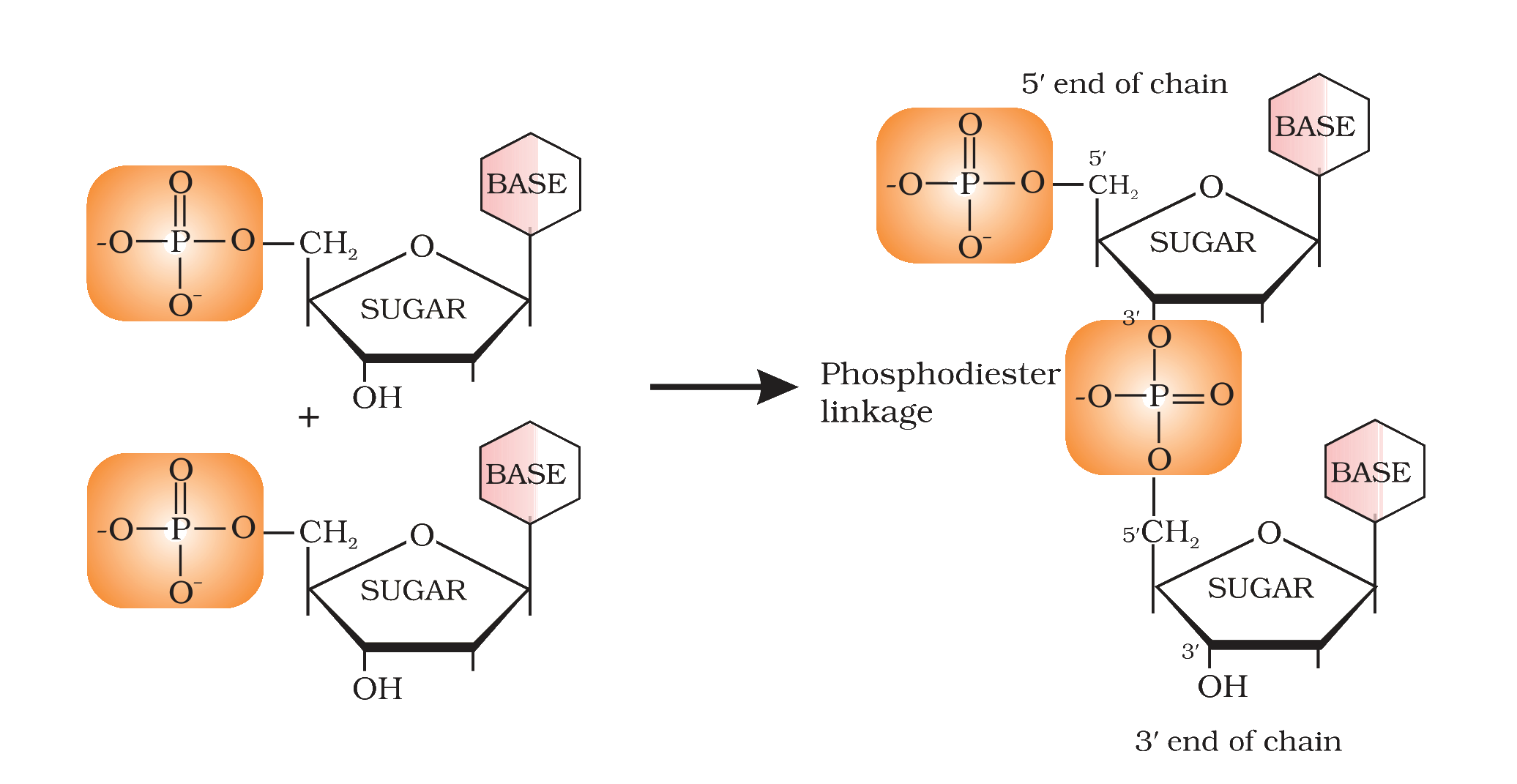
Fig. 10.6: Formation of a dinucleotide