
FACTORS AFFECTING RATE OF REACTION:
The rate of a chemical reaction measures how quickly reactants are consumed or products are formed. It depends on the conditions under which the reaction is carried out.
- Concentration: Generally, an increase in reactant concentration leads to an increase in the reaction rate. This is because a higher concentration provides more reactant particles, leading to a higher collision frequency.
- Temperature: The rate of reaction increases with the increase in temperature. In most cases, the rate of reaction becomes nearly double for 10° rise in temperature.
- Catalysts: Catalysts are substances that accelerate a reaction by providing an alternative reaction pathway with lower activation energy. They increase the rate of reaction without being consumed in the process.
The temperature of a reaction mixture is raised. Consider the following statements about the distribution of kinetic energies of its molecules.
(A) The maximum of the distribution curve moves to a higher energy value.
(B) The total area under the distribution curve remains constant.
(C) The fraction of molecules having energy equal to or greater than the activation energy increases.
(D) The activation energy of the reaction decreases.
Choose the correct answer from the options given below:
Answer & explanation
Correct answer: option 1
The correct answer is Option (1) → (A), (B) and (C) only
The Maxwell–Boltzmann distribution curve plots the fraction of molecules against their kinetic energy. Heating changes the shape of this curve, but not the activation energy of the reaction.
(A) The maximum of the distribution curve moves to a higher energy value. — True. On heating, the peak shifts to higher energy and the curve spreads to the right, so more molecules have much higher energies.
(B) The total area under the distribution curve remains constant. — True. The area stands for the total probability, which is always one, so it does not change with temperature.
(C) The fraction of molecules having energy equal to or greater than the activation energy increases. — True. The shaded area beyond Ea grows; for a 10° rise it nearly doubles, and this is why the rate rises.
(D) The activation energy of the reaction decreases. — False. Raising the temperature changes how many molecules reach Ea, not Ea itself. Increasing the temperature and decreasing the activation energy are two separate ways of raising the rate.
NCERT (2026-27 edition):
3.4 Temperature Dependence of the Rate of a Reaction – “…the maximum of the curve moves to the higher energy value (Fig. 3.9) and the curve broadens out, i.e., spreads to the right such that there is a greater proportion of molecules with much higher energies. The area under the curve must be constant since total probability must be one at all times.”
“Increasing the temperature of the substance increases the fraction of molecules, which collide with energies greater than Ea. It is clear from the diagram that in the curve at (t + 10), the area showing the fraction of molecules having energy equal to or greater than activation energy gets doubled leading to doubling the rate of a reaction.”
“Thus, it has been found from Arrhenius equation … that increasing the temperature or decreasing the activation energy will result in an increase in the rate of the reaction and an exponential increase in the rate constant.”
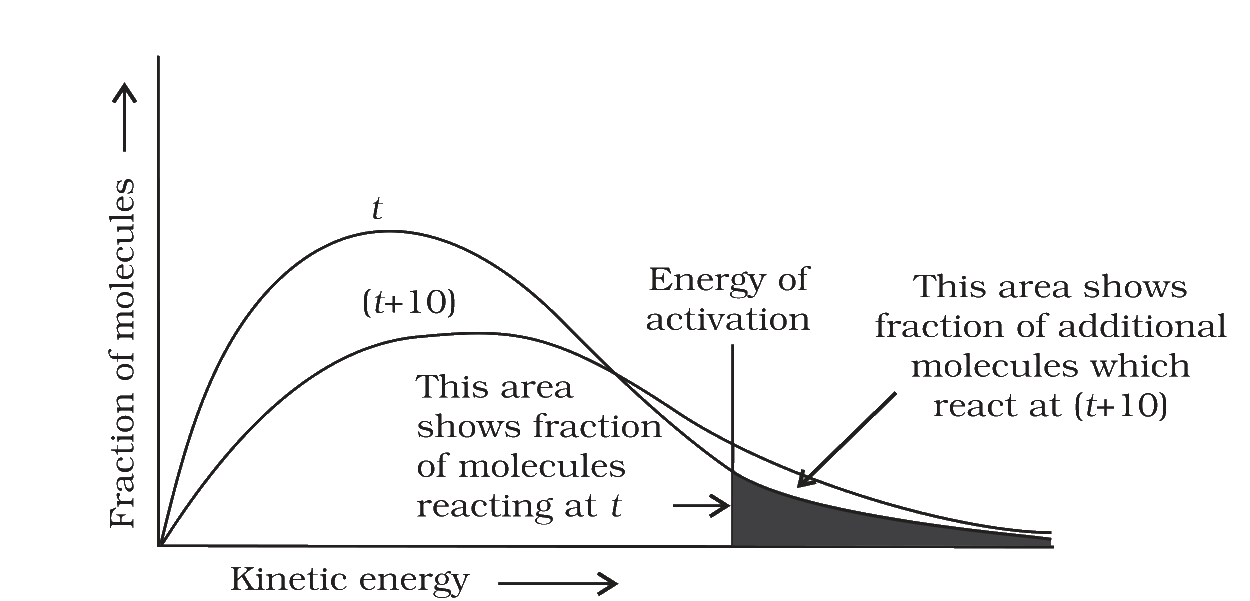
Fig. 3.9: Distribution curve showing temperature dependence of rate of a reaction