
Where would you find the smallest fragments of DNA on a gel during gel electrophoresis?
Answer & explanation
Correct answer: option 1
The correct answer is Option (1) → Near the positive electrode, farthest away from the wells
In gel electrophoresis, DNA fragments are loaded into wells at one end of an agarose gel. DNA is negatively charged, so in an electric field it moves towards the positive electrode (anode). The gel acts like a sieve: smaller fragments move farther, while larger fragments stay closer to the wells.
Option (1) Near the positive electrode, farthest away from the wells — Correct. The smallest fragments pass through the gel most easily. They travel the farthest from the wells, towards the positive electrode (anode).
Option (2) Near the negative electrode, close to the wells — Incorrect. The wells are at the negative electrode (cathode) end. The fragments that stay close to the wells are the largest ones, which the gel slows down most.
Option (3) Near the middle, as they tend to slow down after the first few minutes. — Incorrect. Fragments do not slow down after a few minutes. They keep moving while the current flows, and each one moves at a rate set by its size. The middle of the gel holds fragments of middle size.
NCERT Extract:
Restriction Enzymes – “… Separation and isolation of DNA fragments : The cutting of DNA by restriction endonucleases results in the fragments of DNA. These fragments can be separated by a technique known as gel electrophoresis. Since DNA fragments are negatively charged molecules they can be separated by forcing them to move towards the anode under an electric field through a medium/matrix. Nowadays the most commonly used matrix is agarose which is a natural polymer extracted from sea weeds. The DNA fragments separate (resolve) according to their size through sieving effect provided by the agarose gel. Hence, the smaller the fragment size, the farther it moves.”
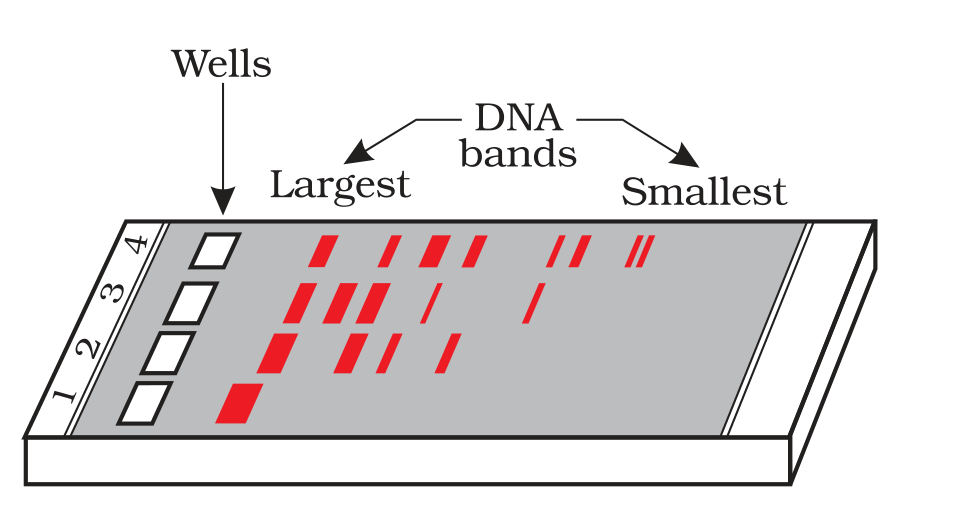
Figure 9.3 A typical agarose gel electrophoresis showing migration of undigested (lane 1) and digested set of DNA fragments (lane 2 to 4)