
Which one of the following equation represent Verhulst Pearl Logistic Growth?
Answer & explanation
Correct answer: option 3
The correct answer is Option (3) → \(\frac{dN}{dt}\) = rN(\(\frac{K-N}{K}\))
A population growing in a habitat with limited resources show initially a lag phase, followed by phases of acceleration and deceleration and finally an asymptote, when the population density reaches the carrying capacity. A plot of N in relation to time (t) results in a sigmoid curve. This type of population growth is called Verhulst-Pearl Logistic Growth.
\(\frac{dN}{dt}\) = rN(\(\frac{K-N}{K}\))
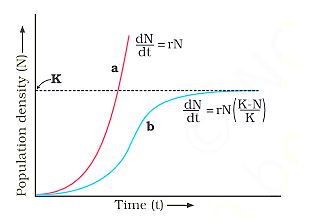
Population growth curve a when responses are not limiting the growth, plot is exponential, b when responses are limiting the growth, plot is logistic, K is carrying capacity