
Read the passage carefully and answer the questions.
Carboxylic acids are the organic compounds which comprise of carboxyl functional group, -COOH. These are generally found in nature, some higher members are known as fatty acids as they occur in natural fats as esters of glycerol. They can be prepared from oxidation of alcohols and aldehydes, hydrolysis of nitriles and amides and Grignard reagents. They are stronger acids than simple phenols and alcohols. but weaker than mineral acids. Substituents affect the acidity of aliphatic and aromatic carboxylic acids. They undergo reactions involving cleavage of -OH and C-OH bond. Carboxylic acids having an alpha hydrogen get halogenated in the presence of red phosphorus to form alpha halo carboxylic acids. The reaction is known as Hell Volhard Zelinsky reaction. Besides these aromatic carboxylic acids undergo electrophilic substitution reactions. They are versatile and are employed in the manufacture of various useful compounds. For example, methanoic acid is used in rubber, textile, dyeing, leather and electroplating industries. Higher fatty acids are used in the manufacture of soaps and detergents. Esters of Benzoic acid are used in perfumery.
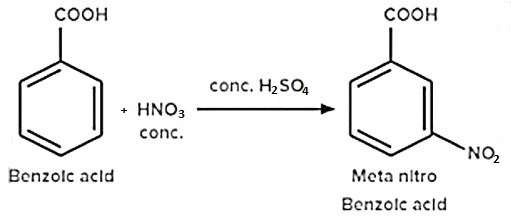
Benzoic acid in the presence of conc. $HNO_3$ and conc. $H_2SO_4$ give major product as
Answer & explanation
Correct answer: option 4
The correct answer is Option (4) → Meta-Nitrobenzoic acid
Core Concept
The -COOH group in benzoic acid is:
- Electron withdrawing (-I and -M effect)
- Deactivating toward electrophilic substitution
- Meta-directing
So during nitration, the nitro group ($-NO_2$) enters mainly at the meta position relative to -COOH.
Option-wise Explanation
1. Ortho-Nitrobenzoic acid
Ortho substitution is favored by electron-donating groups (like $-OH, -NH_2$). Since -COOH withdraws electrons, ortho position becomes less reactive. Steric hindrance from the bulky -COOH group also disfavors ortho substitution.
2. Para-Nitrobenzoic acid
Para substitution is also favored by electron-releasing groups. Because -COOH deactivates the ring and pulls electron density away, the para position is not the most favorable site for attack.
3. Mixture of Ortho and Para-Nitrobenzoic acid
This occurs when the substituent is ortho/para directing (like $-CH_3$ or $-OH$). Benzoic acid does not behave like that, so this option does not match the directing effect of -COOH.
4. Meta-Nitrobenzoic acid
The-COOH group stabilizes the meta-substituted intermediate better than ortho or para intermediates. Therefore, nitration mainly yields meta-nitrobenzoic acid.