CUETMOCK
  • Pricing
  • Mentors
Log inStart freeStart free mocks→

First test, then trust

Try a free CUET mock test.

Join 5,00,000+ students who rehearsed exam day on the exact NTA screen before sitting CUET. On the web and on Android.

Start free mocks →Get the Android app
CUETMOCK

India's #1 CUET Mock Test Platform. Original NCERT-based questions on the exact NTA exam screen — trusted by 5,00,000+ students since CUET 2022.

Get it onGoogle PlayScan to download the CUETMOCK app

Mock tests

  • CUET mock test series
  • Browse all papers
  • Commerce mocks
  • Humanities (Arts) mocks
  • Science mocks
  • Languages & GAT mocks
  • Free practice questions
  • Pricing

Resources

  • CUET exam guide
  • CUET syllabus
  • Universities accepting CUET
  • Expert blogs
  • News & notifications
  • Webinars & counselling
  • CUET score calculator
  • How we estimate your rank
  • FAQs

Company

  • About us
  • Our leadership & team
  • Our toppers
  • Mentors
  • For schools
  • Contact us
  • Terms
  • Privacy
  • Refund policy

Talk to us

+91 7696 6630 56info@cuetmock.comWhatsApp us

Our other platforms

  • JEE Mock — For IIT-JEE aspirants
  • NEET Mock — For NEET aspirants

Newsletter

Exam updates, study material and offers — no spam.

© 2026 NYC Ventures Pvt. Ltd.

701-702, Royal Business Park, Zirakpur, Punjab - 140603

  • Terms of use
  • Privacy policy
  • Refund policy
  • Contact us

iCUETMOCK is an independent preparation platform, not affiliated with the National Testing Agency (NTA). Always check exam details on the official NTA website.

  • Home
  • Mock tests
  • CUET guide
  • Pricing
  • Log in
Home/Practice questions/History
HistoryAncient India: Kings, Farmers and Towns

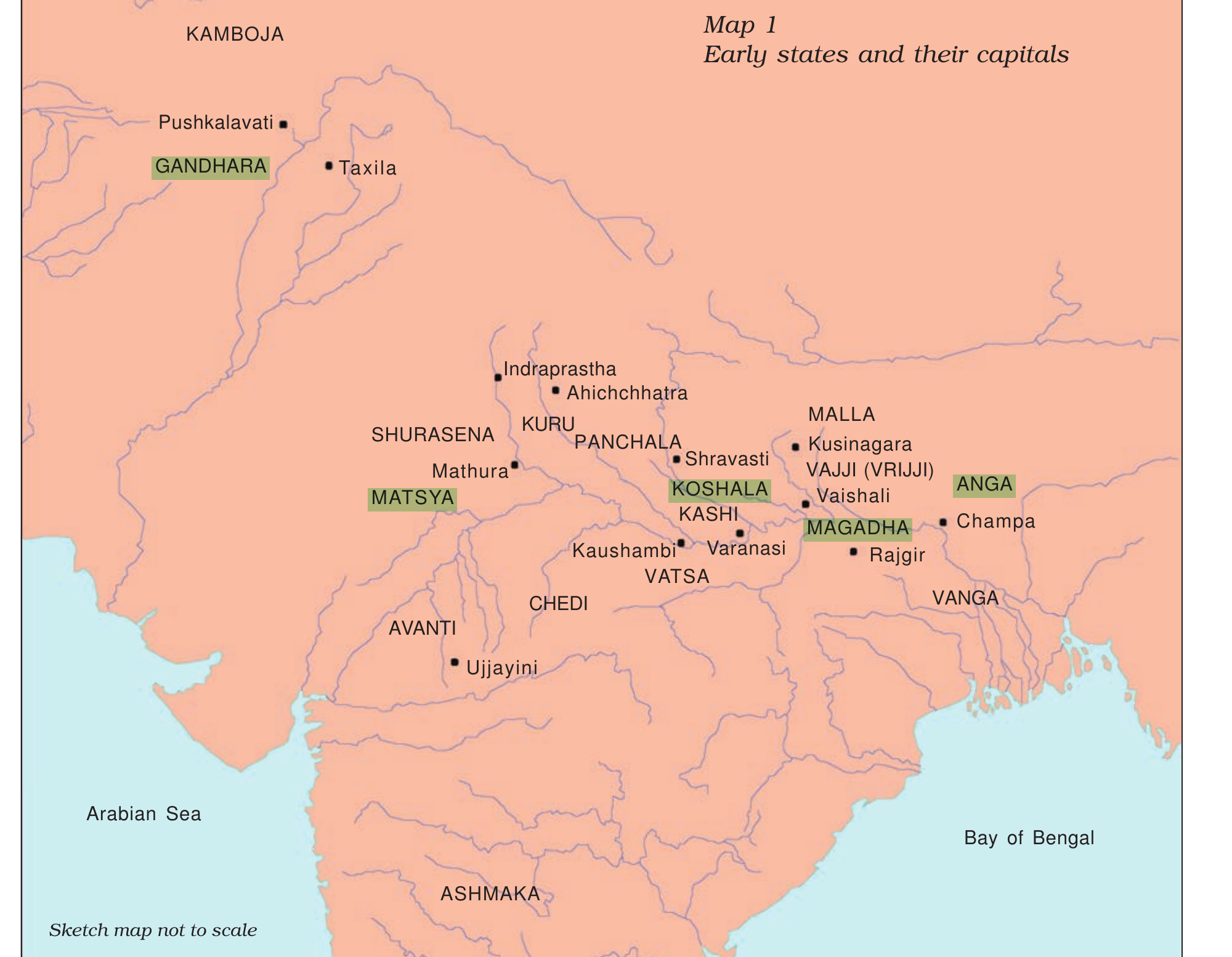
Arrange the following mahajanapadas from West to East. A. KoshalaB. A…

Arrange the following mahajanapadas from West to East.

A. Koshala
B. Anga
C. Magadha
D. Matsya
E. Gandhara

Choose the correct answer from the options given below:

Answer & explanation+

Correct answer: option 3

The correct answer is Option (3) → E, D, A, C, B

These are five of the mahajanapadas, the early states of the sixth century BCE. Their order from west to east is read from the map of the early states and their capitals.

(E) Gandhara — the westernmost, in the far north-west, with Taxila and Pushkalavati.

(D) Matsya — further east, to the south-west of Mathura.

(A) Koshala — further east, in the Ganga valley, with its city Shravasti.

(C) Magadha — east of Koshala, with Rajgir.

(B) Anga — the easternmost, beyond Magadha, with Champa.


NCERT (2026-27): “2.1 The sixteen mahajanapadas … The sixth century BCE is often regarded as a major turning point in early Indian history. It is an era associated with early states, cities, the growing use of iron, the development of coinage, etc. It also witnessed the growth of diverse systems of thought, including Buddhism and Jainism. Early Buddhist and Jaina texts (see also Chapter 4) mention, amongst other things, sixteen states known as mahajanapadas. Although the lists vary, some names such as Vajji, Magadha, Koshala, Kuru, Panchala, Gandhara and Avanti occur frequently. Clearly, these were amongst the most important mahajanapadas.…”

NCERT extract

Advertisement

Practise more on Ancient India: Kings, Farmers and Towns

Chapter-wise mocks on the real NTA exam screen, with solutions and your rank. Your first mocks are free.

Start free mocks →

Advertisement

Next questions

  1. A company forfeited 500 shares of ₹10, called up ₹8 for non payment of allotment money of ₹5. How much amount will be debited to Share Capi…Accountancy Part A · Accounting for Shares
  2. The root of the word ‘hegemony’ lies in which of the following language?Political Science · Contemporary World Politics: US Hegemony in World Politics
  3. Which of the following pairs of postal terms and their meanings, as described by Ibn Battuta for India, is correctly matched?History · Medieval India: Through the Eyes of Travellers
  4. Select the correct Active/Passive form of the given sentence. Young generation doesn’t like being advised what to do.English · Grammar: Active Passive Voice
  5. Citi group was created after the merger of Citicorp and travelers Insurance group. Identify the form of Merger?Entrepreneurship · Enterprise growth Strategies
  6. The degradation of detritus into simpler inorganic substances by the bacterial and fungal enzymes is called as-Biology · Ecosystem
  7. If A=1/3 […] is an orthogonal matrix, thenMaths. Section B1 · Matrices
  8. निम्नलिखित में से कौन अर्थालंकार के भेद हैं ? (A). उपमा(B). रूपक(C). दृष्टान्त(D). अनुप्रास(E). श्लेष नीचे दिए गए विकल्पों में से सही उत्तर…Hindi · Alankar
  9. Select the option that is related to the third letter-cluster in the same way as the second letter-cluster is related to the first letter-c…General Aptitude Test · General Ability
  10. जब तक वह घर पंहुचा तब तक उसके पिताजी जा चुके थे| किस प्रकार का वाक्य है?Hindi · व्याकरण - वाक्य