Read the passage below and answer the questions that follow:-
Arun was an intelligent smart and friendly boy who was very popular amongst his peers. He often did not carry his lunch box to school but would eat from his classmates tiffins, on the sly, under the pretext of checking their bags for bringing mobile phones. He would often regret his behaviour at home but was unable to resist his temptation for interesting food and a little prank. On one such day Arun found Rs. 500/- in a friend's bag. Although he was tempted to take the money to buy food from the canteen, he did not take it, as he understood very well that it would be going too far. Stealing was something his conscience would never allow.
Which structure of personality is completely immersed in the unconscious according to Freud.
Answer & explanation
Correct answer: option 1
The correct answer is Option (1) → Id
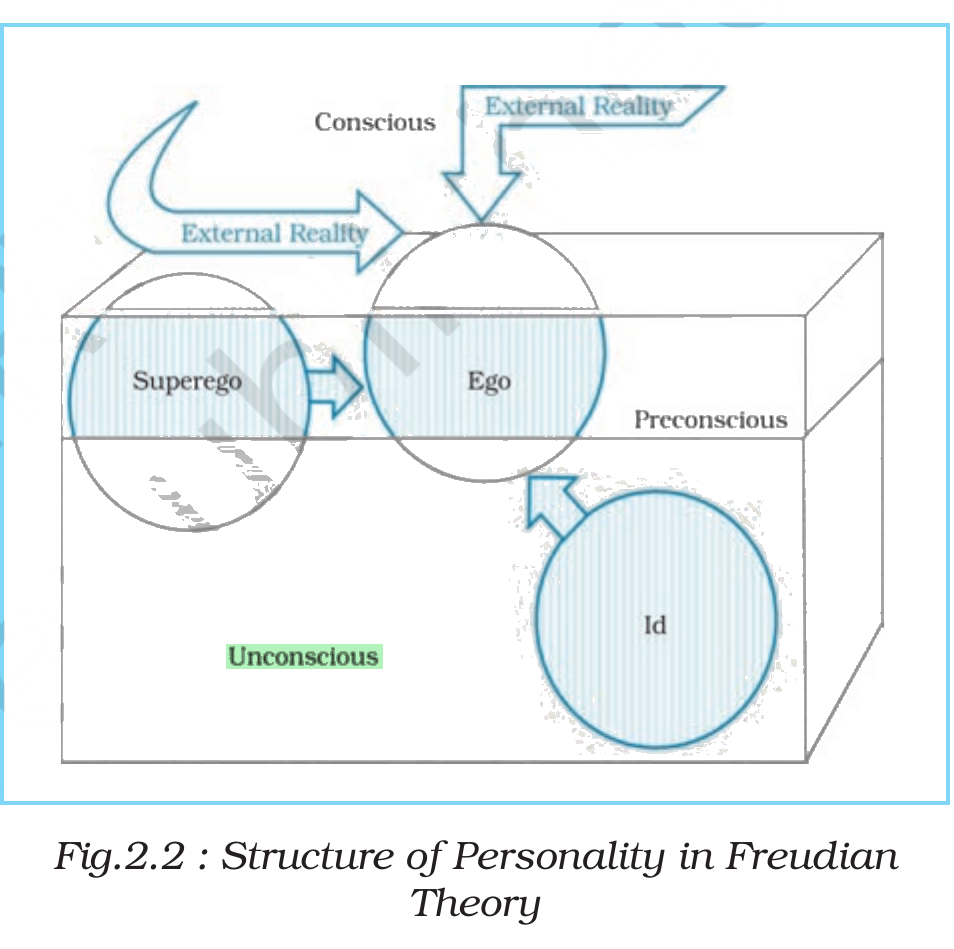
Freud’s picture of the mind has three levels: the conscious, the preconscious and the unconscious, a reservoir of instinctive or animal drives. In his diagram of the structure of personality the id lies wholly in the unconscious, while the ego and the superego reach up into the higher levels.
Option (1) Id — Correct. The id is the source of instinctual energy: primitive needs, sexual desires and aggressive impulses. It works on the pleasure principle and does not care for moral values, society or other people. In that diagram the arrows of external reality reach the ego and the superego but never the id, which sits entirely below the preconscious.
Option (2) Ego — Incorrect. The ego works by the reality principle, so it has to deal with the outside world. In the diagram it reaches up into the conscious and preconscious levels, where external reality meets it.
Option (3) Super-ego — Incorrect. The superego internalises parental authority through socialisation and judges whether a gratification is ethical. In the diagram it stands partly in the preconscious level, so it is not wholly unconscious either.
Option (4) Libido — Incorrect. Libido is the instinctual life force that energises the id, not a structure of personality.
NCERT (2025-26): “Levels of Consciousness … Freud’s theory considers the sources and consequences of emotional conflicts and the way people deal with these. In doing so, it visualises the human mind in terms of three levels of consciousness. The first level is conscious, which includes the thoughts, feelings and actions of which people are aware. The second level is preconscious, which includes mental activity of which people may become aware only if they attend to it closely. The third level is unconscious, which includes mental activity that people are unaware of.…” “Structure of Personality … According to Freud’s theory, the primary structural elements of personality are three, i.e. id, ego, and superego. They reside in the unconscious as forces, and they can be inferred from the ways people behave (see Fig. 2.2). Let us remember that id, ego and superego are concepts, not real physical structures. We will discuss these terms in some detail.” “Id : It is the source of a person’s instinctual energy. It deals with immediate gratification of primitive needs, sexual desires and aggressive impulses. It works on the pleasure principle, which assumes that people seek pleasure and try to avoid pain. Freud considered much of a person’s instinctual energy to be sexual, and the rest as aggressive. Id does not care for moral values, society, or other individuals.…”
|