Identify the major product [A] in the following transformations.
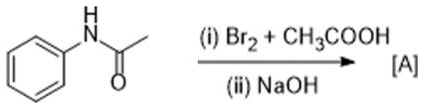
Choose the correct answer from the options given below:
Answer & explanation
Correct answer: option 2
The correct answer is Option (2) → p-Bromoaniline
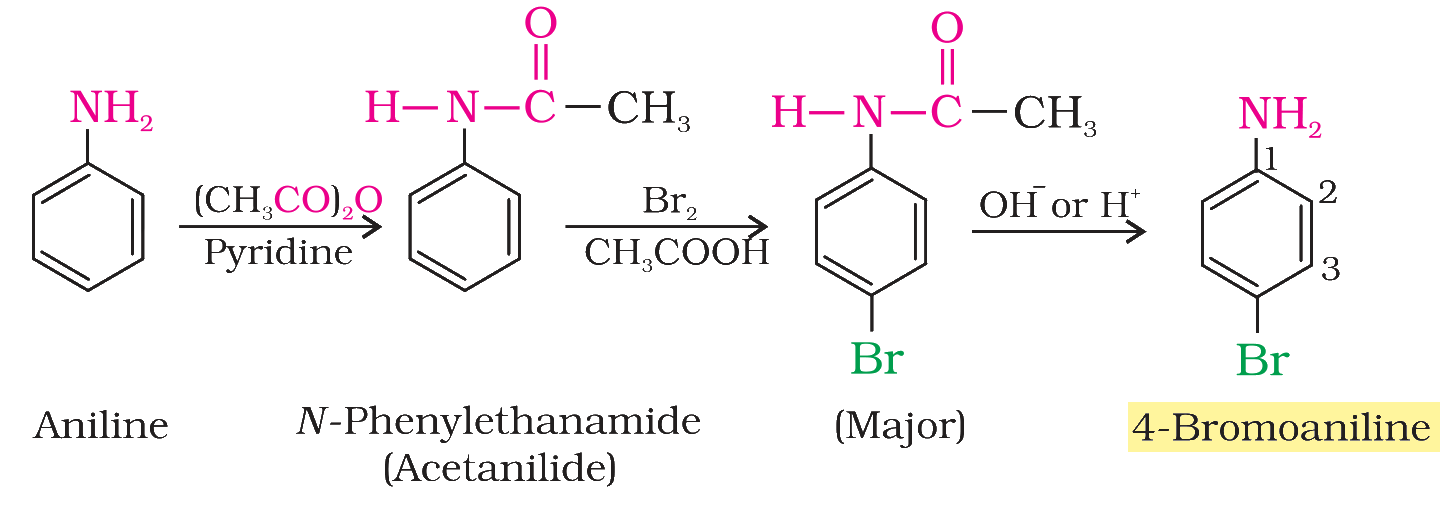
The –\( \ce{NH2} \) group is a very strong activating group. With bromine, aniline reacts at once at both ortho positions and the para position, giving 2,4,6-tribromoaniline. To get a single bromine atom, the activating effect has to be reduced first.
This is done by acetylation. In the –\( \ce{NHCOCH3} \) group, the lone pair on nitrogen is shared with the neighbouring C=O group, so it is less available to the ring. The group is still o,p-directing, but only moderately activating, and its bulk blocks the ortho positions. The protecting group is removed at the end by hydrolysis:
\( \displaystyle \ce{C6H5NH2 + (CH3CO)2O} \xrightarrow{\text{pyridine}} \underset{\text{acetanilide}}{\ce{C6H5NHCOCH3}} + \ce{CH3COOH} \)
\( \displaystyle \ce{C6H5NHCOCH3 + Br2} \xrightarrow{\ce{CH3COOH}} \underset{\text{4-bromoacetanilide}}{\ce{BrC6H4NHCOCH3}} + \ce{HBr} \)
\( \displaystyle \ce{BrC6H4NHCOCH3 + NaOH} \xrightarrow{\Delta} \underset{\text{4-bromoaniline}}{\ce{BrC6H4NH2}} + \ce{CH3COONa} \)
So the product is 4-bromoaniline (p-bromoaniline).
Why the other options are incorrect
Option (1) o-Bromoacetanilide — Incorrect. This is only the minor product of the bromination step, and the hydrolysis step would remove its acetyl group anyway.
Option (3) p-Bromoacetanilide — Incorrect. This is the product of the bromination step only; NaOH in the hydrolysis step hydrolyses the amide.
Option (4) o-Bromoaniline — Incorrect. The ortho position is hindered by the bulky –\( \ce{NHCOCH3} \) group, so this is the minor product.
NCERT (2026-27 edition):
Electrophilic Substitution – “… The main problem encountered during electrophilic substitution reactions of aromatic amines is that of their very high reactivity. Substitution tends to occur at ortho- and para-positions. … This can be done by protecting the -NH2 group by acetylation with acetic anhydride, then carrying out the desired substitution followed by hydrolysis of the substituted amide to the substituted amine.”