
Which of the following complex will be repelled by the applied magnetic field?
Answer & explanation
Correct answer: option 4
The correct answer is Option (4) → [Co(NH3)6]3+
A complex is repelled by an applied magnetic field when it is diamagnetic, i.e. when it has no unpaired electrons. To decide, find the oxidation state of the metal, its d-electron count, and then whether the ligand pairs the electrons:
Strong field ligands (\( \ce{CN^{-}} \), \( \ce{NH3} \), en) give a large splitting Δo, so electrons pair in the lower t2g set (low spin).
Weak field ligands (\( \ce{F^{-}} \), \( \ce{Cl^{-}} \), \( \ce{H2O} \)) give a small splitting, so electrons stay unpaired (high spin).
In \( \ce{[Co(NH3)6]^{3+}} \), Co is +3 (3d6) and \( \ce{NH3} \) pairs all six electrons in t2g, so n = 0 and the complex is diamagnetic.
Why the other options are incorrect
Option (1) [CoF6]3- — Incorrect. x − 6 = −3, so Co is +3 and, as above, \( \ce{Co^{3+}} \) is 3d6; but \( \ce{F^{-}} \) is weak field, so t2g4eg2: 4 unpaired electrons (high spin, paramagnetic).
Option (2) [Cr(NH3)6]3+ — Incorrect. x + 6(0) = +3, so Cr is +3. Cr (Z = 24) is [Ar]3d54s1; losing the 4s electron and two 3d electrons gives \( \ce{Cr^{3+}} \): 3d3. The three electrons occupy the t2g set singly whatever the ligand, so t2g3: 3 unpaired electrons.
Option (3) [Fe(CN)6]3- — Incorrect. x − 6 = −3, so Fe is +3. Fe (Z = 26) is [Ar]3d64s2; losing the two 4s electrons and one 3d electron gives \( \ce{Fe^{3+}} \): 3d5. \( \ce{CN^{-}} \) is strong field, so the electrons pair as far as possible, t2g5: still 1 unpaired electron.
NCERT (2026-27 edition):
Valence Bond Theory – …
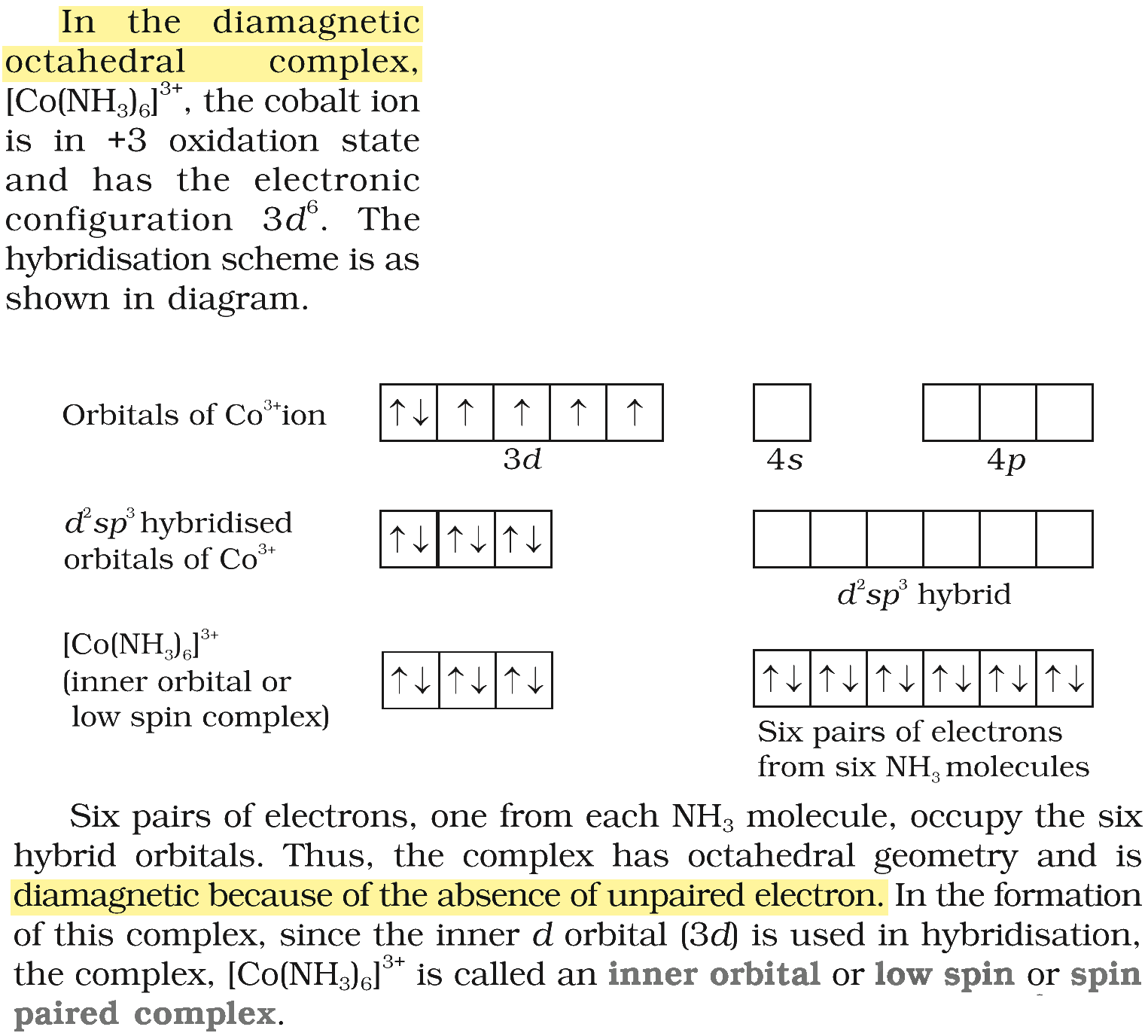
Note: The same/similar question has been asked in different years by NTA as per the details given below:
| 2026 | 2025 | 2024 | 2023 | 2022 |
|---|---|---|---|---|
| 30-05 S2 25-05 S1 | – | – | – | – |