
In the given pedigree chart ‘P’ is a female suffering from a disease, which is denoted by ‘A’ dominant allele and ‘a’ recessive allele ? Find the genotype of ‘P’.
Answer & explanation
Correct answer: option 4
The correct answer is Option (4) → aa
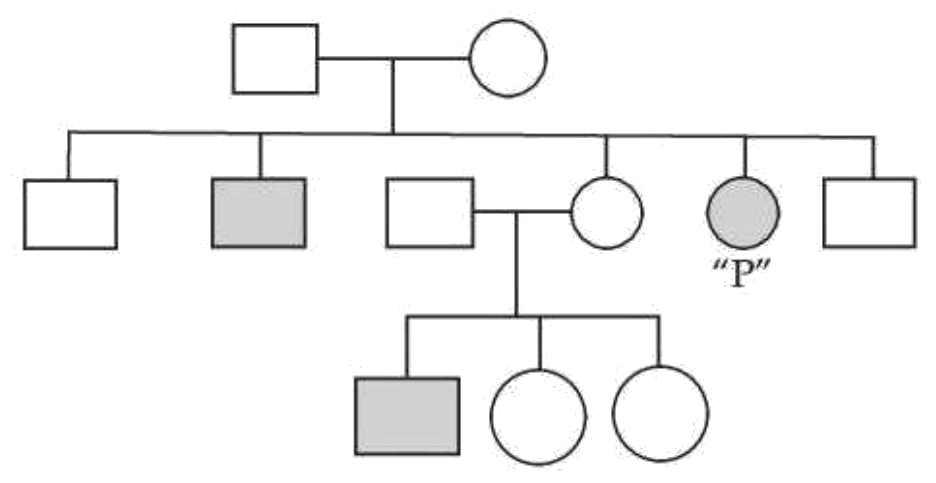
The mode of inheritance is fixed from the pedigree, generation by generation.
- Generation I: both parents are unaffected.
- Generation II: they have an affected son and an affected daughter, ‘P’. Two normal parents can have an affected child only if both carry a hidden allele. So the disease is recessive, and each parent is a carrier.
- Generation III: a normal daughter of generation II and her normal husband also have an affected son. This again shows a recessive trait passed on by carriers.
The trait is also not X-linked. For a daughter to show an X-linked recessive trait, she must get the recessive allele from her father too, and a father with that allele on his single X would himself be affected. Here the father of ‘P’ is unaffected, so the trait is not X-linked. It is autosomal recessive.
Working: Aa (father) × Aa (mother) → gametes A, a from each → AA : Aa : aa = 1 : 2 : 1. Only aa shows the disease, so ‘P’ is aa.
Option (1) AA — Incorrect. AA carries two dominant (normal) alleles. Such a person is unaffected by a recessive disease.
Option (2) XAX — Incorrect. This writes the gene on the X chromosome, but the trait is not X-linked. The symbol is also incomplete, with no allele on the second X.
Option (3) XAXA — Incorrect. This is a female with two dominant alleles on her X chromosomes. The gene is not on the X, and two dominant alleles would make her normal for a recessive disease.
Option (4) aa — Correct. An affected person in an autosomal recessive disease is homozygous recessive.