
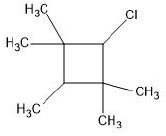
What are the number of chiral centers in the given Alkyl halide
Answer & explanation
Correct answer: option 3
The correct answer is Option (3) → 0
A chiral centre is a carbon atom bonded to four different groups. In a ring, the two ring paths leaving a carbon count as two of its groups, and they are different only if they meet different atoms on the way round.
Number the ring carbons from the one carrying Cl: C1 has H and Cl, C2 has two \( \ce{CH3} \) groups, C3 (opposite C1) has one \( \ce{CH3} \) and one H, and C4 has two \( \ce{CH3} \) groups.
C1 (CHCl): the path through C2 meets \( \ce{C(CH3)2} \) then \( \ce{CH(CH3)} \), and the path through C4 meets \( \ce{C(CH3)2} \) then \( \ce{CH(CH3)} \): the two ring paths are identical, so C1 is not chiral.
C2 and C4: each carries two identical \( \ce{CH3} \) groups, so neither is chiral.
C3 (CH–CH3): its two ring paths both lead through \( \ce{C(CH3)2} \) to the CHCl carbon, so they are identical and C3 is not chiral.
The molecule has a plane of symmetry through C1, C3 and the Cl atom. So the number of chiral centres is 0.
NCERT (2026-27 edition):
Molecular Asymmetry, Chirality and Enantiomers – “… As you can see very clearly, propan-2-ol (A) does not contain an asymmetric carbon, as all the four groups attached to the tetrahedral carbon are not different.”
Molecular Asymmetry, Chirality and Enantiomers – “… Butan-2-ol has four different groups attached to the tetrahedral carbon and as expected is chiral.”