The correct structure of dipeptide, Gly-Ala (glycyl alanine) is
Answer & explanation
Correct answer: option 1
The correct answer is Option (1) → H2N – CH2 – CO – NH – CH(CH3) – COOH
Note: The given answer is as per the official NTA Answer Key. However, there is more than one correct option for this question, as explained below.
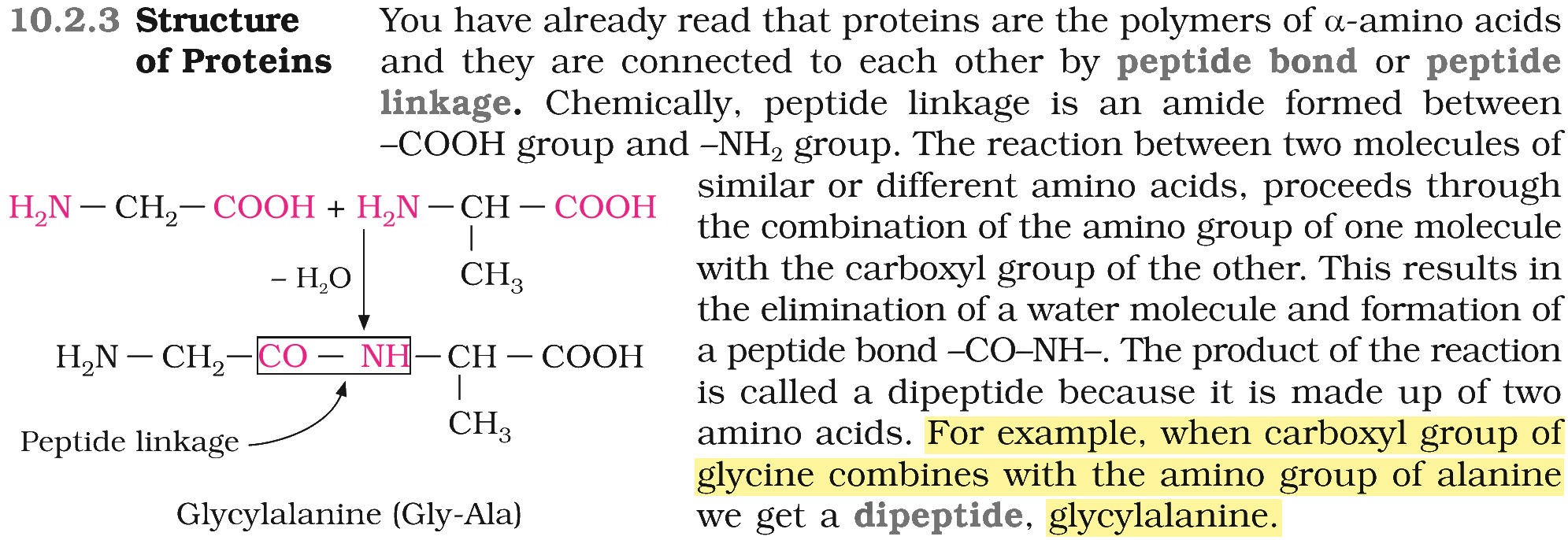
A peptide bond (–CO–NH–) forms when the –COOH group of one amino acid combines with the –\( \ce{NH2} \) group of another, with loss of water. A dipeptide is named from its N-terminal amino acid (free –\( \ce{NH2} \)) to its C-terminal amino acid (free –COOH). In Gly-Ala, the carboxyl group of glycine joins the amino group of alanine, so glycine keeps its free –\( \ce{NH2} \) and alanine keeps its free –COOH:
\( \displaystyle \underset{\text{glycine}}{\ce{H2N-CH2-COOH}}+\underset{\text{alanine}}{\ce{H2N-CH(CH3)-COOH}}\ \ce{->}\ \underset{\text{Gly-Ala}}{\ce{H2N-CH2-CO-NH-CH(CH3)-COOH}}+\ce{H2O} \)
Option (1) H2N – CH2 – CO – NH – CH(CH3) – COOH — Correct. This is the structure above, written from the N-terminal end.
Option (3) HOOC – CH(CH3) – NH – CO – CH2 – NH2 — Is also correct. It is the same molecule written from the C-terminal end: read from right to left it is \( \ce{H2N-CH2-CO-NH-CH(CH3)-COOH} \), with the –CO– next to the glycine \( \ce{CH2} \) and the free –COOH on the alanine carbon.
Why the other options are incorrect
Option (2) HOOC – CH2 – NH – CO – CH(CH3) – NH2 — Incorrect. Here glycine (\( \ce{CH2} \)) carries the free –COOH and alanine the free –\( \ce{NH2} \), so this is Ala-Gly, written from its C-terminal end.
Option (4) H2N – CH(CH3) – CO – NH – CH2 – COOH — Incorrect. This is also Ala-Gly (alanyl glycine), the same molecule as Option (2) written from the other end.
NCERT (2026-27 edition):
Structure of Proteins