
The figure shows a commercial dry cell.
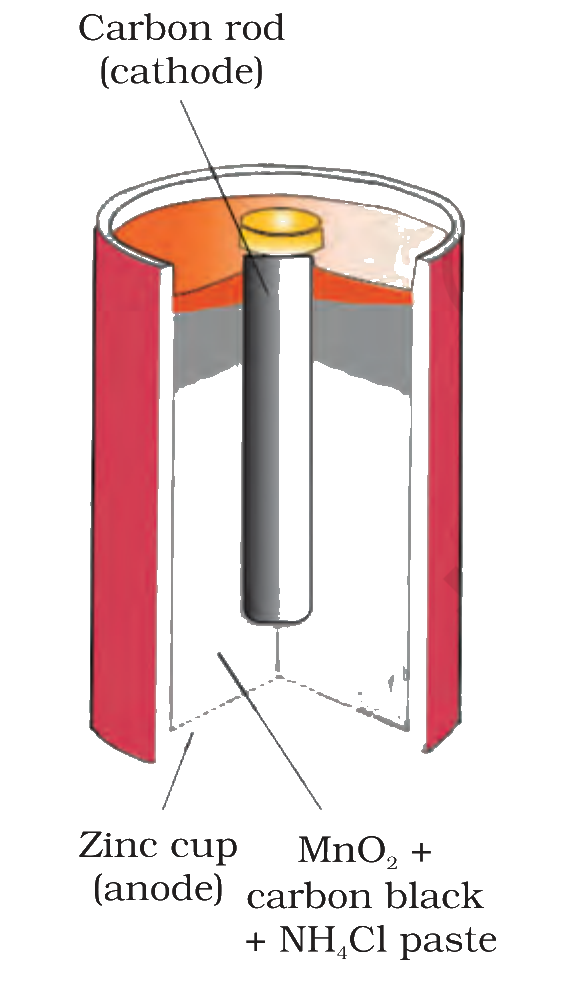
While the cell is in use, the oxidation state of manganese in the paste around the carbon rod changes. What is this change?
Answer & explanation
Correct answer: option 2
The correct answer is Option (2) → From +4 to +3
The figure labels the carbon rod as the cathode and shows it surrounded by a paste of MnO2, carbon black and NH4Cl. Reduction takes place at the cathode, so manganese is reduced:
Cathode: \( \ce{MnO2 + NH4^+ + e^- -> MnO(OH) + NH3} \)
Oxidation state of Mn in MnO2: x + 2(–2) = 0, so x = +4.
Oxidation state of Mn in MnO(OH): x + (–2) + (–1) = 0, so x = +3.
Each MnO2 takes up one electron, and manganese changes from +4 to +3.
NCERT (2026-27 edition):
2.6.1 Primary Batteries – “…The cell consists of a zinc container that also acts as anode and the cathode is a carbon (graphite) rod surrounded by powdered manganese dioxide and carbon (Fig.2.8). The space between the electrodes is filled by a moist paste of ammonium chloride (NH4Cl) and zinc chloride (ZnCl2). The electrode reactions are complex, but they can be written approximately as follows :”
Anode: Zn(s) → Zn2+ + 2e–
Cathode: MnO2 + NH4+ + e– → MnO(OH) + NH3
“In the reaction at cathode, manganese is reduced from the + 4 oxidation state to the +3 state.”
Fig. 2.8: A commercial dry cell consists of a graphite (carbon) cathode in a zinc container; the latter acts as the anode.