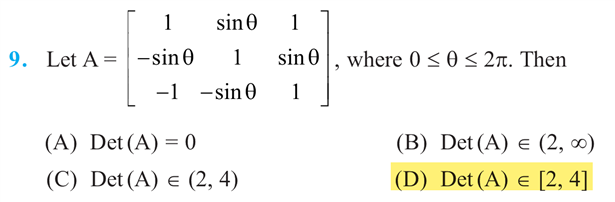
Let \(\Delta=\begin{vmatrix}1 & \sin\theta & 1\\-\sin\theta & 1 & \sin\theta\\-1 & -\sin\theta & 1\end{vmatrix}\), then \(\Delta\) lies in the interval:
Answer & explanation
Correct answer: option 2
The correct answer is Option (2) → [2, 4]
Expanding along the first row:
\( \Delta=1(1+\sin^2\theta)-\sin\theta(-\sin\theta+\sin\theta)+1(\sin^2\theta+1) \)
\( =1+\sin^2\theta-0+\sin^2\theta+1 \)
\( =2+2\sin^2\theta \)
Since \(\sin^2\theta\) takes every value from 0 to 1:
\( 0\le\sin^2\theta\le 1 \)
\( 2\le 2+2\sin^2\theta\le 4 \)
So \(\Delta\) lies in [2, 4], reaching 2 at \(\theta=0\) and 4 at \(\theta=\frac{\pi}{2}\).
NCERT (2026-27 edition):
Determinants