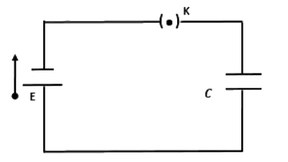
A parallel plate capacitor (C) is connected to a battery as shown in figure. Consider two cases:
Case-I: key 'k' is kept closed and plates of capacitors are moved apart using insulating handle.
Case-II: Initially key 'k' is closed for a long time and then opened. Now, the plates of capacitors are moved apart using insulating handle. Then, identify the correct statements among the following.
(A) In case-I: Q remains same but C changes.
(B) In case-II : V remains same but C changes.
(C) In case-I: V remains same and hence Q changes.
(D) In case-II: Q remains same and hence V changes.
Choose the correct answer from the options given below:
Answer & explanation
Correct answer: option 2
The correct answer is Option (2) → (C) and (D) only
Moving the plates apart increases d, so the capacitance \( C = \varepsilon_0 A/d \) decreases in both cases. What stays fixed depends on whether the battery is still connected.
In case I the key is closed, so the battery holds the potential difference fixed at E; the charge \( Q = CV \) falls as C falls. In case II the key is opened first, so the plates are isolated and the charge stays fixed; the potential difference \( V = Q/C \) rises as C falls.
(A) In case-I: Q remains same but C changes. — Incorrect. With the battery connected, V stays the same and Q changes.
(B) In case-II : V remains same but C changes. — Incorrect. With the battery disconnected, Q stays the same and V increases.
(C) In case-I: V remains same and hence Q changes. — Correct. V = E is fixed, so Q = CE decreases with C.
(D) In case-II: Q remains same and hence V changes. — Correct. No charge can leave the isolated plates, so V = Q/C increases.
NCERT Exemplar:
Electrostatic Potential and Capacitance – …