
On prolonged heating with \(HI\), glucose forms
Answer & explanation
Correct answer: option 3
The correct answer is option 3. n-Hexane.
Glucose is a simple sugar (monosaccharide).HI (hydrogen iodide) acts as a strong reducing agent.Upon prolonged heating with HI, glucose undergoes a cleavage reaction. The carbon chain of glucose breaks down, and the hydrogen from HI reduces the aldehyde group of glucose.This reaction results in the formation of a straight-chain alkane with six carbon atoms, which is n-hexane \((C_6H_12).
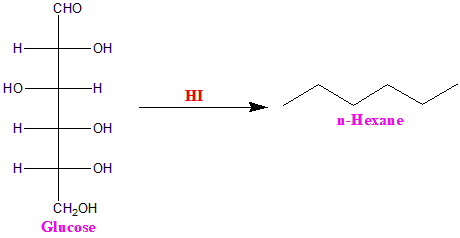
The other options are not formed by this reaction:
Starch: Starch is a complex carbohydrate (polysaccharide) formed by linking glucose units together. HI wouldn't convert glucose into a more complex molecule.
Gluconic acid: Gluconic acid is formed when glucose is oxidized at the aldehyde carbon. HI acts as a reducing agent, not an oxidizing agent.
Fructose: Fructose is another monosaccharide isomer of glucose. HI wouldn't convert glucose into a different sugar molecule under these conditions.