
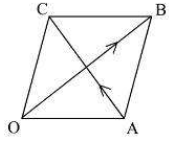
OABC is a parallelogram. If \(\overrightarrow{OB} = \vec{a}\) and \(\overrightarrow{AC} = \vec{b}\), then \(\overrightarrow{OA}\) is equal to
Answer & explanation
Correct answer: option 2
The correct answer is Option (2) → \(\displaystyle\frac{\vec{a}-\vec{b}}{2}\)
In the parallelogram OABC, opposite sides are equal and parallel, so \(\overrightarrow{AB} = \overrightarrow{OC}\).
By the triangle law of addition in triangle OAB:
\(\overrightarrow{OB} = \overrightarrow{OA} + \overrightarrow{AB}\)
\(\vec{a} = \overrightarrow{OA} + \overrightarrow{OC} \qquad (1)\)
In triangle OAC:
\(\overrightarrow{AC} = \overrightarrow{OC} - \overrightarrow{OA}\)
\(\vec{b} = \overrightarrow{OC} - \overrightarrow{OA} \qquad (2)\)
Subtracting (2) from (1) removes \(\overrightarrow{OC}\):
\(\vec{a} - \vec{b} = 2\,\overrightarrow{OA}\)
\( \displaystyle \overrightarrow{OA} = \frac{\vec{a}-\vec{b}}{2} \)
Why the other options are incorrect
Option (1) \(\vec{a}-\vec{b}\) — Incorrect. \(\vec{a}-\vec{b}\) equals \(2\,\overrightarrow{OA}\), twice the required vector.
Option (3) \(\vec{a}+\vec{b}\) — Incorrect. Adding (1) and (2) gives \(\vec{a}+\vec{b} = 2\,\overrightarrow{OC}\), twice the side OC, not \(\overrightarrow{OA}\).
Option (4) \(\displaystyle\frac{\vec{a}+\vec{b}}{2}\) — Incorrect. By the same addition this is \(\overrightarrow{OC}\), the other side from O.