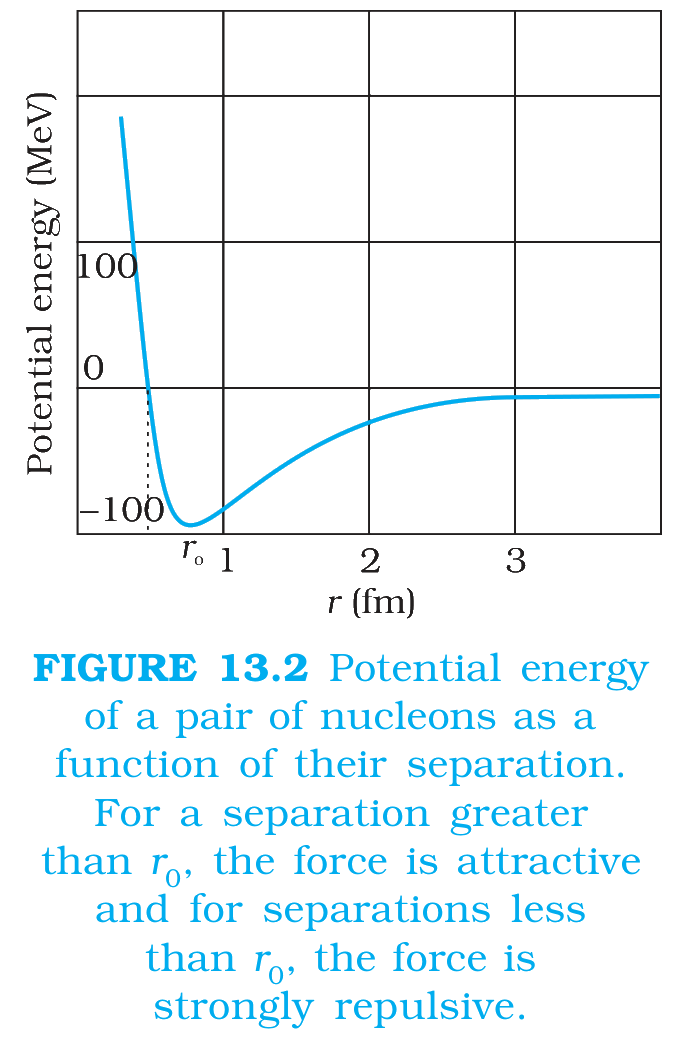
Match List-I (separation \(r\) between two nucleons) with List-II (nature of the nuclear interaction).
| List-I | List-II |
|---|---|
| (A) \(r\) less than 0.8 fm | (I) The nuclear force is practically zero |
| (B) \(r\) about 0.8 fm | (II) The force is strongly repulsive |
| (C) \(r\) a little more than 0.8 fm, say 1.5 fm | (III) The potential energy is a minimum |
| (D) \(r\) much more than a few femtometres, say 10 fm | (IV) The force is attractive |
Choose the correct answer from the options given below:
Answer & explanation
Correct answer: option 2
The correct answer is Option (2) → (A)-(II), (B)-(III), (C)-(IV), (D)-(I)
(A) \( r \) less than 0.8 fm — This matches (II). When two nucleons are pushed closer than 0.8 fm, the potential energy rises steeply. The force between them is then strongly repulsive.
(B) \( r \) about 0.8 fm — This matches (III). The potential energy curve has its lowest point at \( r_0 \approx 0.8\ \mathrm{fm} \).
(C) \( r \) a little more than 0.8 fm — This matches (IV). Beyond \( r_0 \) the potential energy rises as \( r \) increases, so the nucleons pull each other back. The force is attractive.
(D) \( r \) much more than a few femtometres — This matches (I). The nuclear force is short-ranged and dies out beyond a few femtometres.
NCERT (2026-27):
Nuclear Force – “A rough plot of the potential energy between two nucleons as a function of distance is shown in the Fig. 13.2. The potential energy is a minimum at a distance r0 of about 0.8 fm. …”
Nuclear Force – “… This means that the force is attractive for distances larger than 0.8 fm and repulsive if they are separated by distances less than 0.8 fm.”
Nuclear Force – “(ii) The nuclear force between two nucleons falls rapidly to zero as their distance is more than a few femtometres. …”