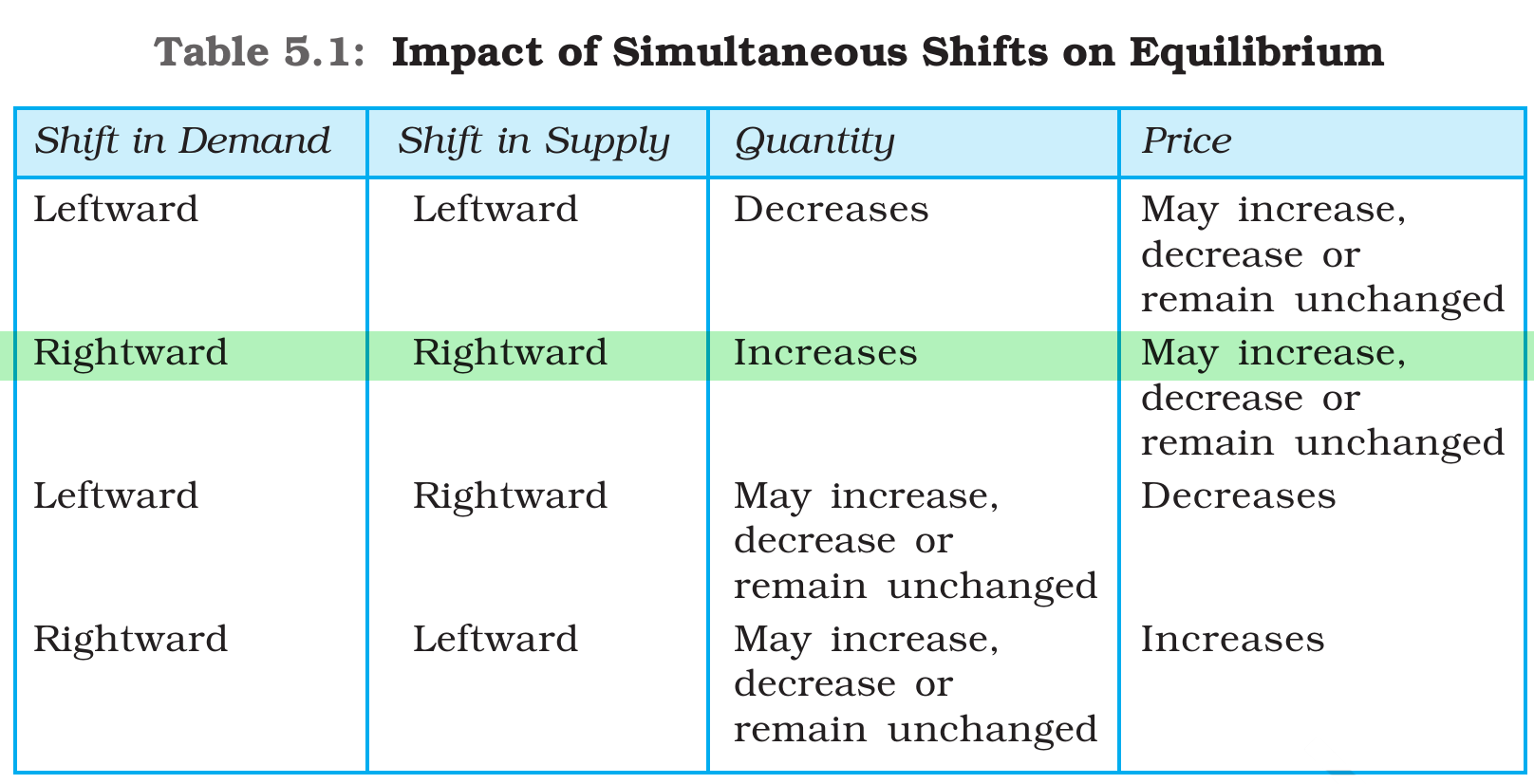
What happens when both demand and supply curves shift rightwards simultaneously? Identify the correct statements from the following in this context.
(A) Quantity will increase.
(B) Quantity will decrease.
(C) Quantity will remain unchanged.
(D) Price may increase, decrease or remain unchanged.
Choose the correct answer from the options given below:
Answer & explanation
Correct answer: option 3
The correct answer is Option (3) → (A) and (D) only
The price and the quantity of a good settle where the demand curve meets the supply curve; this point is the market equilibrium. A rightward shift of a curve means that more is demanded, or offered, at every price: demand shifts right when, for example, consumers’ incomes rise, and supply shifts right when, say, a better technology lowers the cost of production.
Take the two shifts one at a time:
Only demand shifts right: at the old price buyers want more than sellers offer, so there is excess demand; the price rises, and the equilibrium quantity rises.
Only supply shifts right: at the old price sellers offer more than buyers want, so there is excess supply; the price falls, and the equilibrium quantity rises.
When both shifts happen together, their effects on quantity point the same way, so the quantity increases for certain. Their effects on price pull in opposite directions, so the price can rise, fall or stay the same, depending on which shift is larger.
(A) Quantity will increase. Correct. Both shifts raise the quantity bought and sold, so the equilibrium quantity increases whatever the size of the shifts.
(B) Quantity will decrease. Incorrect. Neither shift reduces the quantity, so a fall in quantity is not possible when both curves move to the right.
(C) Quantity will remain unchanged. Incorrect. The quantity could stay the same only if one shift pushed it down, and both push it up.
(D) Price may increase, decrease or remain unchanged. Correct. The demand shift pushes the price up and the supply shift pushes it down, so the result depends on the size of the two shifts. If demand shifts more, the price rises; if supply shifts more, it falls; if the two shifts are equal, it stays where it was.
NCERT (2025-26): “Simultaneous Shifts of Demand and Supply … What happens when both demand and supply curves shift simultaneously? The simultaneous shifts can happen in four possible ways: (i) Both supply and demand curves shift rightwards. (ii) Both supply and demand curves shift leftwards. (iii) Supply curve shifts leftward and demand curve shifts rightward. (iv) Supply curve shifts rightward and demand curve shifts leftward. The impact on equilibrium price and quantity in all the four cases are given in Table 5.1. Each row of the table describes the direction in which the equilibrium price and quantity will change for each possible combination of the simultaneous shifts in demand and supply curves. For instance, from the second row of the table, we see that due to a rightward shift in both demand and supply curves, the equilibrium quantity increases invariably but the equilibrium price may either increase, decrease or remain unchanged. The actual direction in which the price will change will depend on the magnitude of the shifts. Check this yourself by varying the magnitude of shifts for this particular case. In the first two cases which are shown in the first two rows of the table, the impact on equilibrium quantity is unambiguous but the equilibrium price may change, if at all, in either direction depending on the magnitudes of shifts. In the next two cases, shown in the last two rows of the table, the effect on price is unambiguous whereas effect on quantity depends on the magnitude of shifts in the two curves.”
|