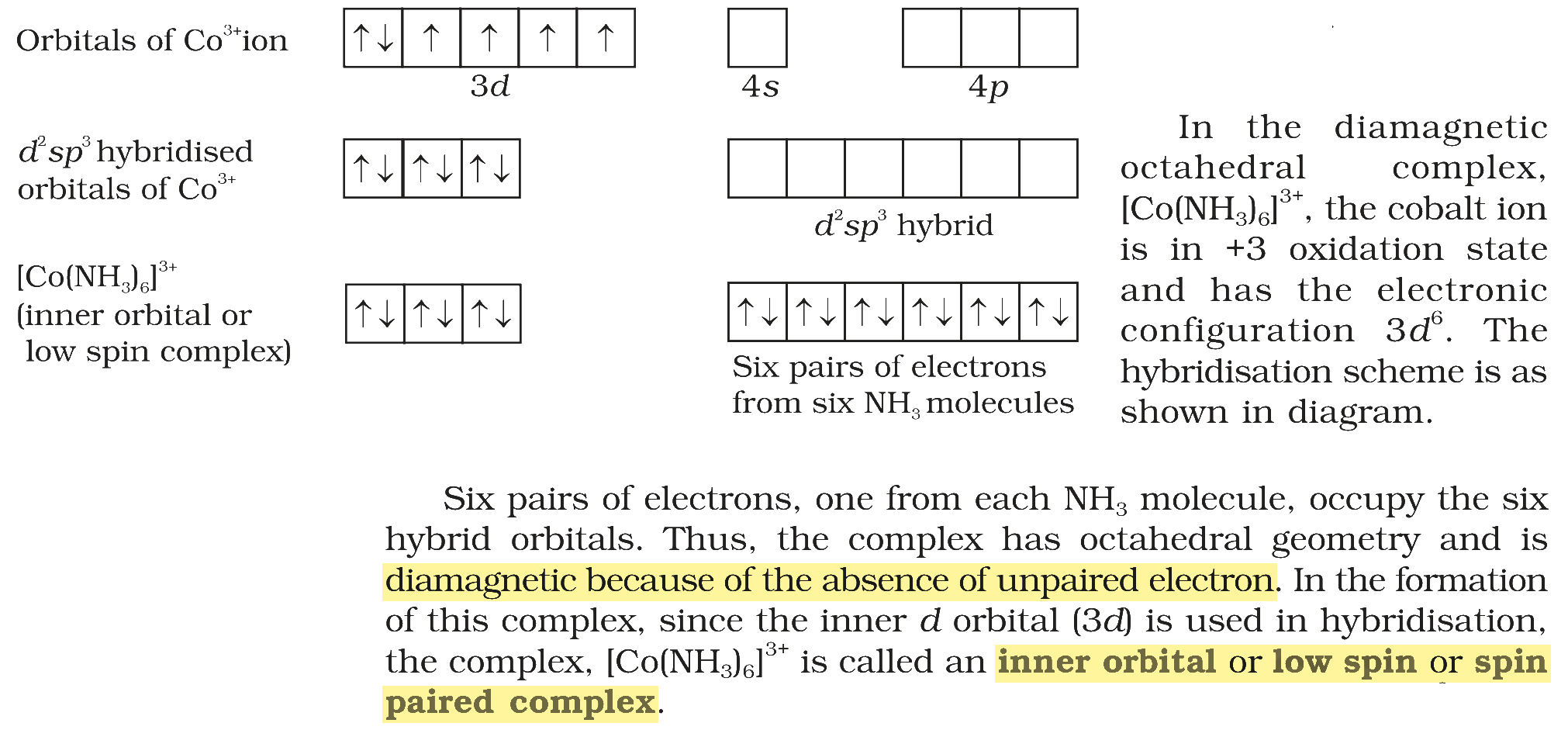
According to the valence bond theory, the metal atom or ion under the influence of ligands can use its (n-1)d, ns, np, nd orbitals for hybridization to yield a set of equivalent orbitals of definite geometry. These hybridized orbitals are allowed to overlap with ligand orbitals that can donate electron pairs for bonding. It is usually possible to predict the geometry of a complex from the knowledge of its magnetic behaviour on the basis of the valence bond theory. Consider the formation of \([Co(NH_3)_5Cl]Cl_2\) and answer the following question:
The spin only magnetic moment of the complex \([Co(NH_3)_5Cl]Cl_2\) in BM is:
Answer & explanation
Correct answer: option 2
The correct answer is Option (2) → 0.0
In \( \ce{[Co(NH3)5Cl]^{2+}} \), x + 5(0) + (−1) = +2, so cobalt is +3. Co (Z = 27) has 27 − 18 = 9 electrons beyond the argon core: [Ar]3d74s2. \( \ce{Co^{3+}} \) is formed by losing the two 4s electrons and one 3d electron: [Ar]3d6.
In the free \( \ce{Co^{3+}} \) ion the six d electrons follow Hund’s rule:
3d: [↑↓] [↑ ] [↑ ] [↑ ] [↑ ] (4 unpaired)
In the complex the ammine ligands make the electrons pair up, so that two 3d orbitals are left empty for d2sp3 hybridisation (as in \( \ce{[Co(NH3)6]^{3+}} \)):
3d: [↑↓] [↑↓] [↑↓] [ ] [ ]
There are no unpaired electrons (n = 0), so the complex is diamagnetic:
\( \displaystyle \mu = \sqrt{n(n+2)} = \sqrt{0} = 0\ \mathrm{BM} \)
NCERT (2026-27 edition):
Valence Bond Theory – …