
Solve the following Linear Programming Problem Graphically.
Maximize $Z = 6x + y$
Subject to constraints: $2x + y ≥ 3,y – x ≥ 0, x ≥ 0$, and $y ≥ 0$.
Answer & explanation
Correct answer: option 4
The correct answer is Option (4) → No maximum value (Unbounded)
By plotting the given linear inequalities, we can see that the inequality $2 x + y ≥ 3$ meets the co-ordinates axes at the point (1.5, 0) and (0, 3) respectively.
Similarly, the inequality $y – x ≥ 0$ meets the co-ordinate axis at the point O (0, 0) respectively.
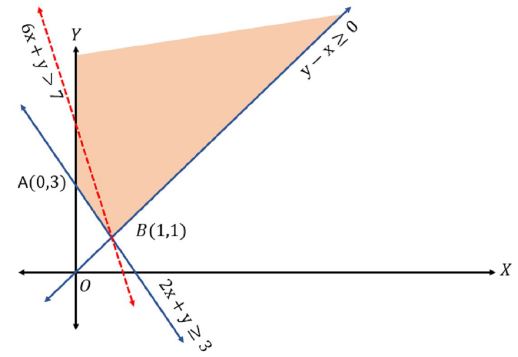
As shown in the graph above, the shaded feasible region is unbounded.
The coordinates of the vertices (corner point) of the shaded feasible region are A (0, 3), and B (1, 1).
The value of the objective function as these points are given in the following table:
|
Corner Points |
Coordinates |
Objective Function $Z=6x + y$ |
|
A |
(0,3) |
3 |
|
B |
(1,1) |
7 (Max.) |
From this table, we find that 7 is the maximum value of Z at the corner point B (1, 1)
As the feasible region is unbounded.
Therefore, 7 may or may not be the maximum value of Z.
To decide this issue, we graph the inequality $6x + y > 7$.
Plot this inequation on the same graph and check whether the resulting open half plane has points in common with the feasible region or not.
As shown in the figure the red line representing the inequality $6x + y > 7$ is passing through corner point B(1, 1) but lies in the feasible region.
Hence the given LP problem has no solution and Z cannot be maximized for any values of x and y.