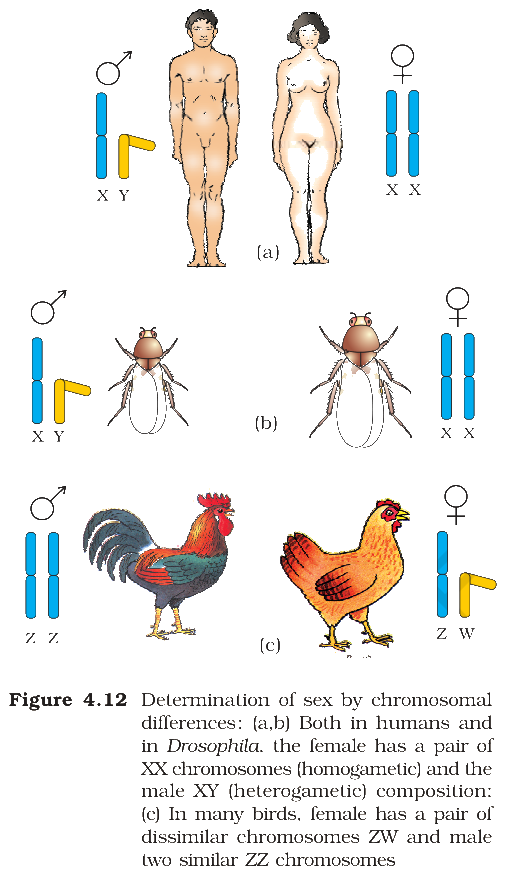
In majority of organisms, determination of sex is by chromosomal differences. Males are heterogametic in:
Answer & explanation
Correct answer: option 1
The correct answer is Option (1) → Humans and Drosophila
A heterogametic sex makes two kinds of gametes. A homogametic sex makes only one kind. In male heterogamety the male is heterogametic (XY or XO). In female heterogamety the female is heterogametic (ZW).
(1) Humans and Drosophila — Correct. In both, the male is XY and makes two kinds of gametes, one with X and one with Y. The female is XX and makes one kind.
(2) Drosophila and birds — Incorrect. Drosophila fits, but in birds the female is ZW and makes two kinds of gametes. The bird male is ZZ.
(3) Honeybee and birds — Incorrect. Birds have female heterogamety. The honeybee uses the haplodiploid system, in which the male develops from an unfertilised egg and is haploid.
(4) Humans and honeybee — Incorrect. Humans fit, but the honeybee male is haploid and has no XY pair, so it is not heterogametic.
NCERT Extract:
Sex Determination – “… In the above description you have studied about two types of sex determining mechanisms, i.e., XO type and XY type. But in both cases males produce two different types of gametes, (a) either with or without X-chromosome or (b) some gametes with X-chromosome and some with Y-chromosome. Such types of sex determination mechanism is designated to be the example of male heterogamety. In some other organisms, e.g., birds, a different mechanism of sex determination is observed (Figure 4.12 c). In this case the total number of chromosome is same in both males and females. But two different types of gametes in terms of the sex chromosomes, are produced by females, i.e., female heterogamety.”
Sex Determination – “… In human beings and in Drosophila the males have one X and one Y chromosome, whereas females have a pair of X-chromosomes besides autosomes (Figure 4.12 a, b).”