Match List-I with List-II:
| List-I Event | List-II Year | ||
| (A) | Regulating Act passed by the British Parliament | (I) | 1818 |
| (B) | Permanent Settlement in Bengal | (II) | 1773 |
| (C) | First revenue settlement in the Bombay Deccan | (III) | 1875 |
| (D) | Ryots in Deccan villages rebel | (IV) | 1793 |
Choose the correct answer from the options given below.
Answer & explanation
Correct answer: option 2
The correct answer is Option (2) → (A)-(II), (B)-(IV), (C)-(I), (D)-(III)
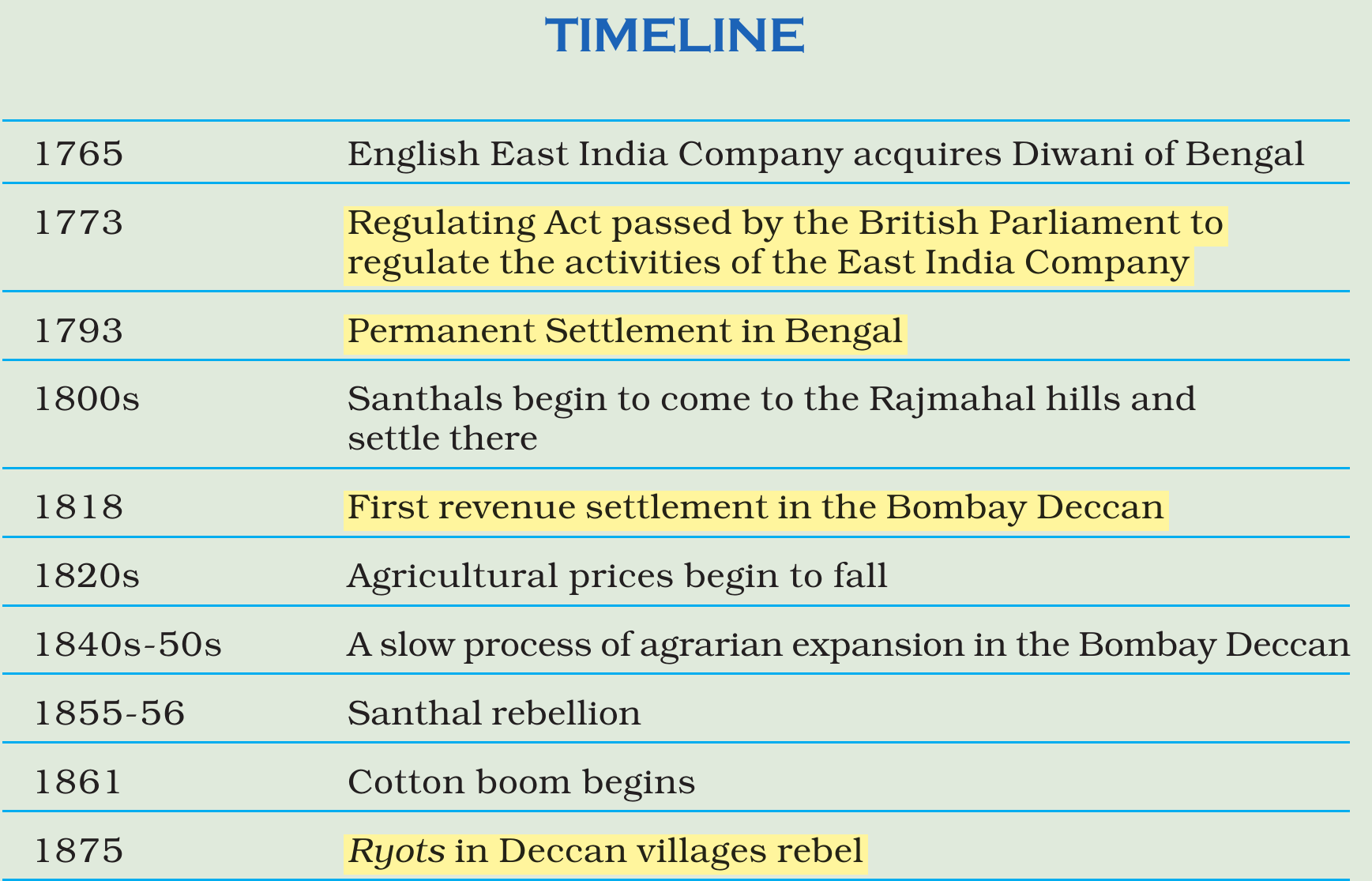
(A) Regulating Act passed by the British Parliament — this matches (II) 1773. The Act was passed to regulate the activities of the East India Company, a few years after the Company acquired the Diwani of Bengal in 1765.
(B) Permanent Settlement in Bengal — this matches (IV) 1793. Under it the rajas and taluqdars of Bengal, now classified as zamindars, had to pay a revenue demand that was fixed in perpetuity.
(C) First revenue settlement in the Bombay Deccan — this matches (I) 1818. The chapter timeline places the first revenue settlement in the Bombay Deccan in 1818, twenty-five years after the Permanent Settlement in Bengal.
(D) Ryots in Deccan villages rebel — this matches (III) 1875. In this year the ryots of the Deccan revolted against the moneylenders and grain dealers; the movement began at Supa in Poona district.
NCERT: Themes in Indian History Part III — Chapter 9: Colonialism and the Countryside (2025-26)
|