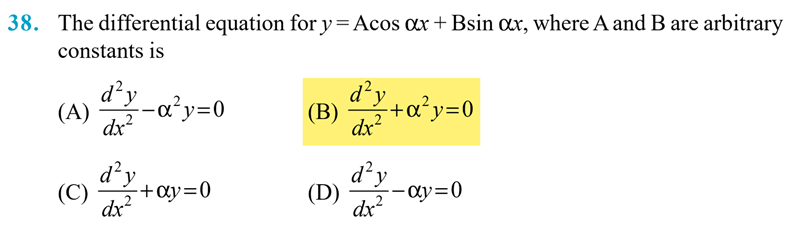
The differential equation for \(y=A\cos(\alpha x)+B\sin(\alpha x)\), where A and B are arbitrary constants is:
Answer & explanation
Correct answer: option 1
The correct answer is Option (1) → \(\displaystyle\frac{d^2y}{dx^2}+\alpha^2y=0\)
There are two arbitrary constants, so we differentiate twice and eliminate A and B:
\(\displaystyle \frac{dy}{dx} = -A\alpha\sin(\alpha x)+B\alpha\cos(\alpha x)\)
\(\displaystyle \frac{d^2y}{dx^2} = -A\alpha^2\cos(\alpha x)-B\alpha^2\sin(\alpha x)\)
\(\displaystyle = -\alpha^2\left[A\cos(\alpha x)+B\sin(\alpha x)\right] = -\alpha^2y\)
\(\displaystyle \frac{d^2y}{dx^2}+\alpha^2y = 0\)
Why the other options are incorrect
Option (2) \(\displaystyle\frac{d^2y}{dx^2}-\alpha^2y=0\) — Incorrect. Differentiating cos and sin twice brings a minus sign, so \(y'' = -\alpha^2y\), not \(+\alpha^2y\).
Option (3) \(\displaystyle\frac{d^2y}{dx^2}+\alpha y=0\) — Incorrect. Each differentiation brings a factor \(\alpha\) (chain rule), so the factor is \(\alpha^2\), not \(\alpha\).
Option (4) \(\displaystyle\frac{d^2y}{dx^2}-\alpha y=0\) — Incorrect. Both the sign and the power of \(\alpha\) are wrong.
NCERT Exemplar:
Differential Equations