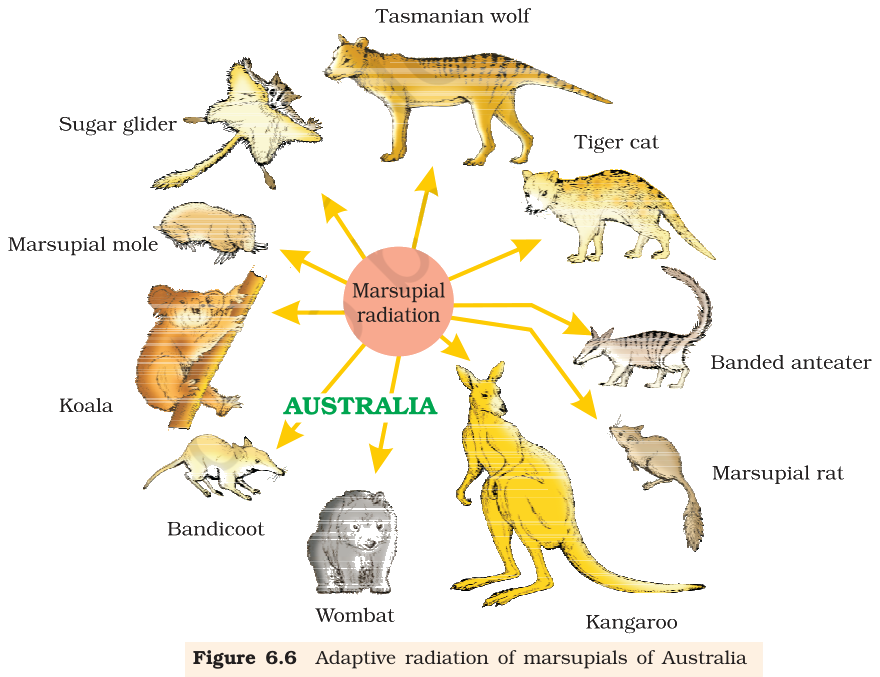
Australian marsupials show the phenomena of:
Answer & explanation
Correct answer: option 2
The correct answer is Option (2) → Adaptive radiation
Option (1) Convergent evolution — Incorrect. Convergent evolution makes unrelated organisms look alike in similar habitats. NCERT uses it for the likeness between Australian marsupials and placental mammals (the marsupial mole and the placental mole), not for the marsupials among themselves.
Option (2) Adaptive radiation — Correct. Many different marsupials, such as the kangaroo, koala, wombat and Tasmanian wolf, evolved from one ancestral stock within Australia.
Option (3) Isolation — Incorrect. Australia's isolation gave the marsupials room to spread, but isolation is a condition, not the evolutionary pattern they show.
Option (4) Saltation — Incorrect. Saltation is a single large mutation causing a new species at one step, as de Vries suggested.
NCERT Extract:
What Is Adaptive Radiation? – “… From the original seed-eating features, many other forms with altered beaks arose, enabling them to become insectivorous and vegetarian finches (Figure 6.5). This process of evolution of different species in a given geographical area starting from a point and literally radiating to other areas of geography (habitats) is called adaptive radiation. Darwin’s finches represent one of the best examples of this phenomenon. Another example is Australian marsupials. A number of marsupials, each different from the other (Figure 6.6) evolved from an ancestral stock, but all within the Australian island continent.”