
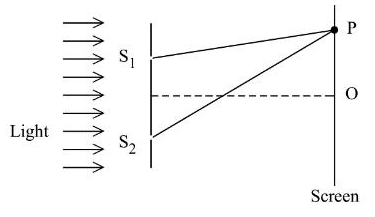
In the double slit experiment, coherent light of frequency \( 5\times10^{14}\,\mathrm{Hz} \) is incident on two narrow parallel slits \( S_1 \) and \( S_2 \). The central bright band is formed at O on the screen. The next bright band is formed at P on the screen (as shown in the figure). The speed of light is \( 3\times10^{8}\,\mathrm{m\,s^{-1}} \), the distance \( (S_2P - S_1P) \) is:
Answer & explanation
Correct answer: option 3
The correct answer is Option (3) → \( 0.6\,\mu\mathrm{m} \)
A bright fringe forms where the two waves arrive in phase, that is, where the path difference is a whole number of wavelengths, \( S_2P - S_1P = n\lambda \). The central band O has \( n = 0 \), so the next bright band P, which is the first one beyond it, has \( n = 1 \).
\( \displaystyle \lambda = \frac{c}{\nu} = \frac{3\times10^{8}\,\mathrm{m\,s^{-1}}}{5\times10^{14}\,\mathrm{Hz}} = 6\times10^{-7}\,\mathrm{m} = 0.6\,\mu\mathrm{m} \)
\( S_2P - S_1P = 1\times\lambda = 0.6\,\mu\mathrm{m} \)