Suppose in an economy, the legal reserve ratio fixed by the Central Bank is 20% and the value of initial deposits is Rs.1000 crores. What is the value of loans extended by Commercial Banks?
Answer & explanation
Correct answer: option 2
The correct answer is Option (2) → Rs.4000 crores
Given:
Legal reserve ratio (LRR) = 20% = 0.2
Initial deposits = Rs.1000 crores
Banks must keep a part of their deposits as reserves, and they can lend the rest. This ratio is also called the required reserve ratio or Cash Reserve Ratio. Each loan returns as a new deposit, until the whole initial deposit is held as required reserves:
Total deposits = Initial deposits × 1/LRR
Total deposits = 1000 × 1/0.2 = Rs.5000 crores
Loans are the total deposits minus the money held as reserves:
Loans = 5000 − 1000 = Rs.4000 crores
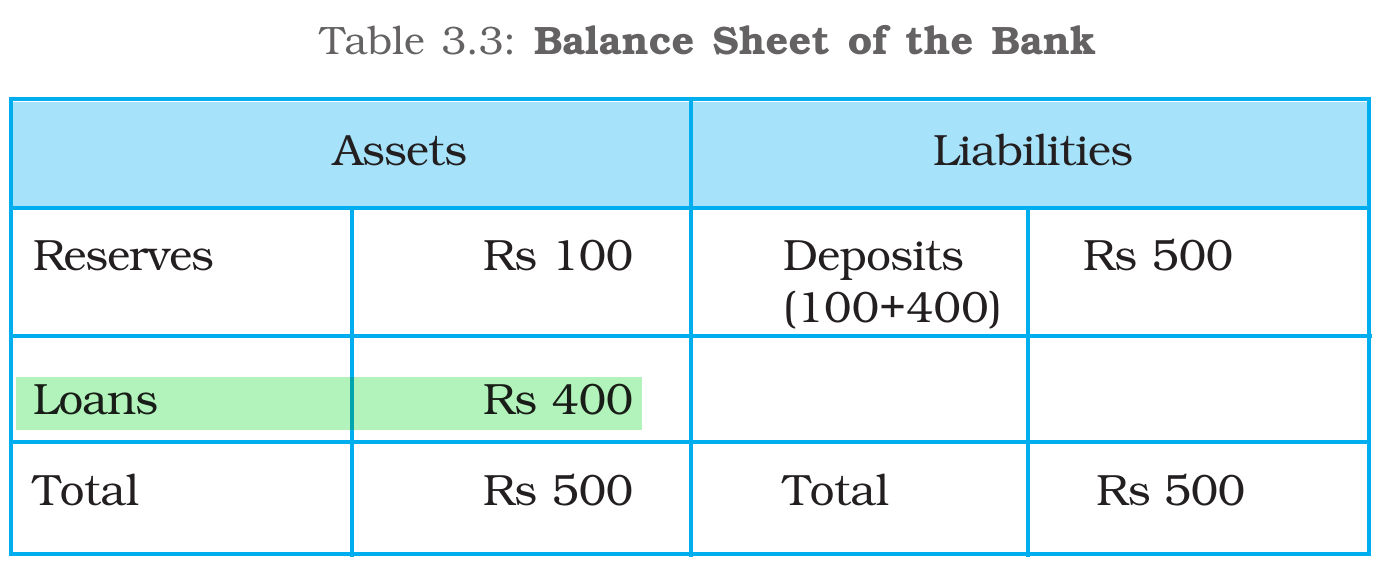
NCERT (2026-27): “3.3.2 Limits to Credit Creation and Money Multiplier … The RBI decides a certain percentage of deposits which every bank must keep as reserves. This is done to ensure that no bank is ‘over lending’. This is a legal requirement and is binding on the banks. This is called the ‘Required Reserve Ratio’ or the ‘Reserve Ratio’ or ‘Cash Reserve Ratio’ (CRR).… …Since the bank is only expected to keep 20 per cent of its deposits as reserves, thus, reserves of Rs 100 (20per cent of 500 = 100) can support the deposits of Rs 500. In other words, our bank can give a loan of Rs 400. Table 3.3 demonstrates its balance sheet.
|