
CUETMOCK
  • Pricing
  • Mentors
Log inStart freeStart free mocks→

First test, then trust

Try a free CUET mock test.

Join 5,00,000+ students who rehearsed exam day on the exact NTA screen before sitting CUET. On the web and on Android.

Start free mocks →Get the Android app
CUETMOCK

India's #1 CUET Mock Test Platform. Original NCERT-based questions on the exact NTA exam screen — trusted by 5,00,000+ students since CUET 2022.

Get it onGoogle PlayScan to download the CUETMOCK app

Mock tests

  • CUET mock test series
  • Commerce mocks
  • Humanities (Arts) mocks
  • Science mocks
  • Languages & GAT mocks
  • Free practice questions
  • Pricing

Resources

  • CUET exam guide
  • CUET syllabus
  • Universities accepting CUET
  • Expert blogs
  • News & notifications
  • Webinars & counselling
  • CUET score calculator
  • How we estimate your rank
  • FAQs

Company

  • About us
  • Our leadership & team
  • Our toppers
  • Mentors
  • For schools
  • Contact us
  • Terms
  • Privacy
  • Refund policy

Talk to us

+91 7696 6630 56info@cuetmock.comWhatsApp us

Our other platforms

  • JEE Mock — For IIT-JEE aspirants
  • NEET Mock — For NEET aspirants

Newsletter

Exam updates, study material and offers — no spam.

© 2026 NYC Ventures Pvt. Ltd.

701-702, Royal Business Park, Zirakpur, Punjab - 140603

  • Terms of use
  • Privacy policy
  • Refund policy
  • Contact us

iCUETMOCK is an independent preparation platform, not affiliated with the National Testing Agency (NTA). Always check exam details on the official NTA website.

  • Home
  • Mock tests
  • CUET guide
  • Pricing
  • Log in
Home/Practice questions/Chemistry
ChemistryPhysical: Electro Chemistry

Match List-I with List-II.List-I(Half-cell reaction)List-II(E°/V at 2…

Match List-I with List-II.

List-I
(Half-cell reaction)
List-II
(E°/V at 298 K)
(A) \( \ce{F2(g) + 2e^- -> 2F^-} \)(I) −0.76
(B) \( \ce{Ag+ + e^- -> Ag(s)} \)(II) 2.87
(C) \( \ce{Zn^2+ + 2e^- -> Zn(s)} \)(III) −3.05
(D) \( \ce{Li+ + e^- -> Li(s)} \)(IV) 0.80

Choose the correct answer from the options given below:

Answer & explanation+

Correct answer: option 4

The correct answer is Option (4) → A-II, B-IV, C-I, D-III

Standard electrode potentials are measured against the standard hydrogen electrode (E° = 0). The higher the E°, the greater the tendency of the oxidised form to be reduced; a negative E° means the metal reduces H+ ions more easily than hydrogen does.

(A) \( \ce{F2(g) + 2e^- -> 2F^-} \) — This matches (II) 2.87. Fluorine has the highest E° in the series; F2 is the strongest oxidising agent.

(B) \( \ce{Ag+ + e^- -> Ag(s)} \) — This matches (IV) 0.80. The value is positive, so Ag+ ions are reduced more easily than H+ ions.

(C) \( \ce{Zn^2+ + 2e^- -> Zn(s)} \) — This matches (I) −0.76. The value is negative: hydrogen ions can oxidise zinc.

(D) \( \ce{Li+ + e^- -> Li(s)} \) — This matches (III) −3.05. Lithium has the lowest E°; lithium metal is the most powerful reducing agent in aqueous solution.

NCERT (2026-27 edition):
2.2.1 Measurement of Electrode Potential – “Similarly, the measured emf of the cell: Pt(s) H2(g, 1 bar) H+ (aq, 1 M) Zn2+ (aq, 1M) Zn is –0.76 V corresponding to the standard electrode potential of the half-cell reaction: Zn2+ (aq, 1 M) + 2e– → Zn(s)”

“…The values of standard electrode potentials for some selected half-cell reduction reactions are given in Table 2.1. … It can be seen that the standard electrode potential for fluorine is the highest in the Table indicating that fluorine gas (F2) has the maximum tendency to get reduced to fluoride ions (F–) and therefore fluorine gas is the strongest oxidising agent and fluoride ion is the weakest reducing agent. Lithium has the lowest electrode potential indicating that lithium ion is the weakest oxidising agent while lithium metal is the most powerful reducing agent in an aqueous solution.”

Table 2.1: Standard Electrode Potentials at 298 K
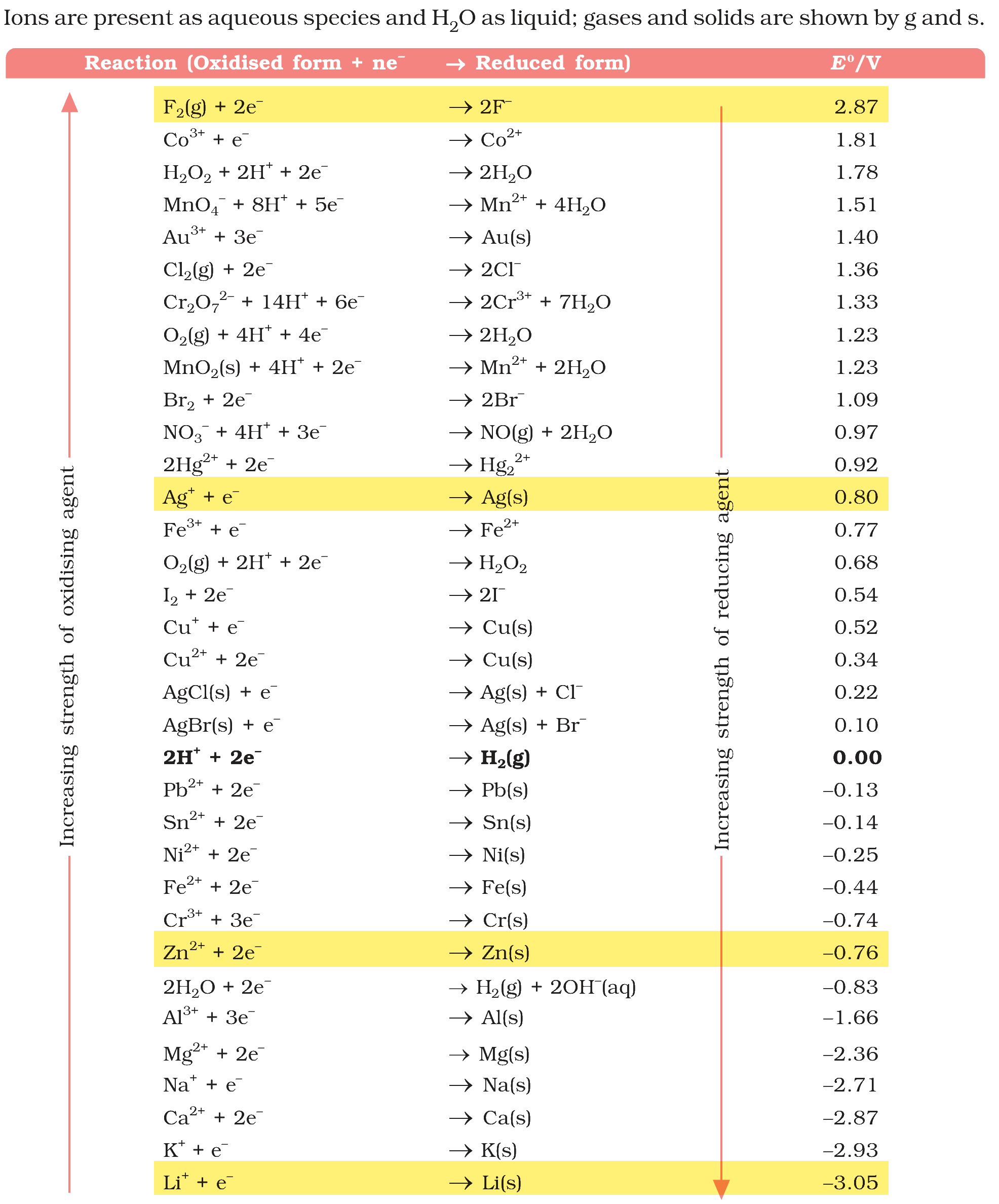
Table 2.1

Advertisement

Practise more on Physical: Electro Chemistry

Chapter-wise mocks on the real NTA exam screen, with solutions and your rank. Your first mocks are free.

Start free mocks →

Advertisement

Next questions

  1. Who was the youngest person to be awarded the Nobel Prize before Malala Yousafzai?General Aptitude Test · General Knowledge
  2. Choose the correct statements about the naming of restriction enzymes:A. The first letter of the name comes from the genus of the prokaryot…Biology · Biotechnology -Principles and Processes
  3. If a planet of given density were made larger, its force of attraction for an object on its surface would increase because of planet’s grea…Physics · Gravitation
  4. Sentences of a paragraph are given below in jumbled order. Arrange the sentences in the correct order to form a meaningful and coherent par…English · Arrange in Meaningful Sequence
  5. ∫tan x≤ft(sec x-tan x)dx =Maths. Section B1 · Indefinite Integration
  6. Choose the word that means the same as the given word. SacrilegeEnglish · Synonyms
  7. In a factory, there are 39 workers who have been categorised into five groups (A, B, C, D, E) on the basis of the range of their daily wage…General Aptitude Test · Quantitative Reasoning
  8. Assertion (A): A good example of multiple alleles is ABO blood group system. Reason (R): When IA and IB alleles are present together in ABO…Biology · Principles of Inheritance and Variation
  9. Which of the following gases is responsible for deaths in the coal mines?Geography · India-People and Economy: Mineral and Energy resources
  10. Which of the following is NOT an objective of liberalization of trade and investment regime initiated in India as a part of NEP of 1991?Economics · Indian Economic Development: Liberalisation, Privatisation and Globalisation - An Appraisal