
The number of individuals in the reproductive age group is more than the number of individuals in the pre-reproductive age group, the shape of its age pyramid would reflect the growth status of the population as:
Answer & explanation
Correct answer: option 3
The correct answer is Option (3) → Declining
An age pyramid shows the share of pre-reproductive, reproductive and post-reproductive individuals in a population. Its base is the pre-reproductive group, the young who will reproduce in future. A population whose young are fewer than its reproductive adults has a narrow base. Fewer individuals will enter the reproductive age later, so numbers will fall.
Option (1) Expanding — Incorrect. An expanding population has a broad base: many more pre-reproductive individuals than reproductive ones.
Option (2) Stable — Incorrect. In a stable population the pre-reproductive and reproductive groups are about equal, giving a bell shape.
Option (3) Declining — Correct. When the reproductive age group is larger than the pre-reproductive group, fewer young are being added than there are breeding adults. The population is declining, and its age pyramid is narrow at the base (urn-shaped).
Option (4) Homeostasis — Incorrect. Homeostasis is keeping a constant internal environment in an organism’s body. It is not a growth status of a population.
NCERT Extract:
Population Attributes – “… A population at any given time is composed of individuals of different ages. If the age distribution (per cent individuals of a given age or age group) is plotted for the population, the resulting structure is called an age pyramid (Figure 11.1). For human population, the age pyramids generally show age distribution of males and females in a diagram. The shape of the pyramids reflects the growth status of the population - (a) whether it is growing, (b) stable or (c) declining.”
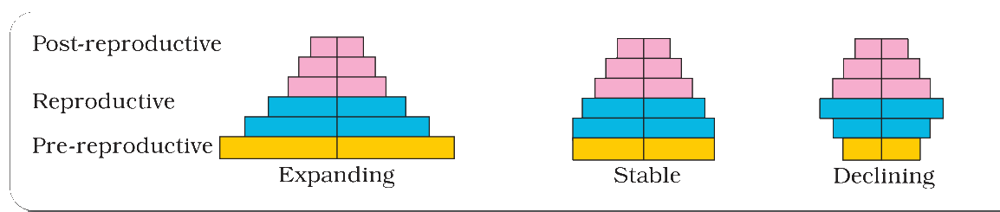
Figure 11.1 Representation of age pyramids for human population