CUETMOCK
  • Pricing
  • Mentors
Log inStart freeStart free mocks→

First test, then trust

Try a free CUET mock test.

Join 5,00,000+ students who rehearsed exam day on the exact NTA screen before sitting CUET. On the web and on Android.

Start free mocks →Get the Android app
CUETMOCK

India's #1 CUET Mock Test Platform. Original NCERT-based questions on the exact NTA exam screen — trusted by 5,00,000+ students since CUET 2022.

Get it onGoogle PlayScan to download the CUETMOCK app

Mock tests

  • CUET mock test series
  • Browse all papers
  • Commerce mocks
  • Humanities (Arts) mocks
  • Science mocks
  • Languages & GAT mocks
  • Free practice questions
  • Pricing

Resources

  • CUET exam guide
  • CUET syllabus
  • Universities accepting CUET
  • Expert blogs
  • News & notifications
  • Webinars & counselling
  • CUET score calculator
  • How we estimate your rank
  • FAQs

Company

  • About us
  • Our leadership & team
  • Our toppers
  • Mentors
  • For schools
  • Contact us
  • Terms
  • Privacy
  • Refund policy

Talk to us

+91 7696 6630 56info@cuetmock.comWhatsApp us

Our other platforms

  • JEE Mock — For IIT-JEE aspirants
  • NEET Mock — For NEET aspirants

Newsletter

Exam updates, study material and offers — no spam.

© 2026 NYC Ventures Pvt. Ltd.

701-702, Royal Business Park, Zirakpur, Punjab - 140603

  • Terms of use
  • Privacy policy
  • Refund policy
  • Contact us

iCUETMOCK is an independent preparation platform, not affiliated with the National Testing Agency (NTA). Always check exam details on the official NTA website.

  • Home
  • Mock tests
  • CUET guide
  • Pricing
  • Log in
Home/Practice questions/Economics
EconomicsIndian Economic Development: Poverty

Small farmers and seasonal workers come under which type of poor?

Small farmers and seasonal workers come under which type of poor?

Answer & explanation+

Correct answer: option 4

The correct answer is Option (4) → Churning poor

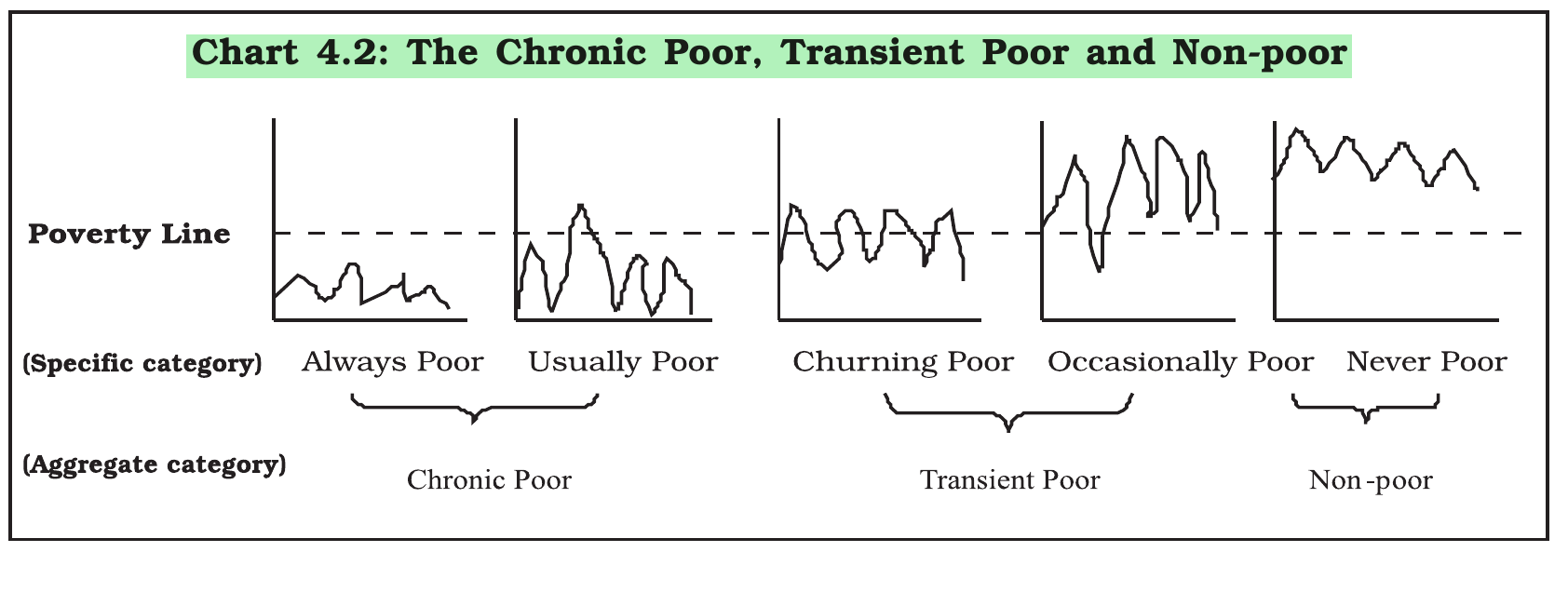
Small farmers and seasonal workers regularly move in and out of poverty. Their income rises in a good season and falls in a bad one. Such people are called the churning poor.

  • Option (1) Always poor — Incorrect. These people are poor all the time and never rise above poverty. They form part of the chronic poor.

  • Option (2) Occasionally poor — Incorrect. These people are rich most of the time but fall into poverty after a patch of bad luck. Small farmers are not rich most of the time.

  • Option (3) Chronic poor — Incorrect. This group is made up of the always poor and the usually poor. The usually poor, such as casual workers, only sometimes have a little more money.

  • Option (4) Churning poor — Correct. They move in and out of poverty again and again, as small farmers and seasonal workers do. Together with the occasionally poor, they are called the transient poor.

Note: This question is taken from the chapter ‘Poverty’ which was there in the pre-rationalised NCERT and has been deleted from subsequent editions of NCERT, including the NCERT book (2026-27). The chapter was also not in the CUET (UG) 2026 syllabus.

NCERT (Pre-rationalised): “4.3 How are Poor People Identified? … Categorising Poverty: There are many ways to categorise poverty. In one such way people who are always poor and those who are usually poor but who may sometimes have a little more money (example: casual workers) are grouped together as the chronic poor. Another group are the churning poor who regularly move in and out of poverty (example: small farmers and seasonal workers) and the occasionally poor who are rich most of the time but may sometimes have a patch of bad luck. They are called the transient poor. And then, there are those who are never poor and they are the non-poor (Chart 4.2).…”

NCERT extract

Advertisement

Practise more on Indian Economic Development: Poverty

Chapter-wise mocks on the real NTA exam screen, with solutions and your rank. Your first mocks are free.

Start free mocks →

Advertisement

Next questions

  1. Select the option that can be used as a one-word substitute for the given group of words. A person who listens to someone’s private convers…English · One Word
  2. Find the range of f(x) = [1+sin x]+≤ft[2+sinx/2]+≤ft[3+sinx/2]+...+≤ft[n+sinx/n] ∀ x∈[0,π],n∈N ([.] denotes greatest integer function).Maths. Section B1 · Relations and Functions
  3. कौन-सा वाक्य व्याकरण की दृष्टि से शुद्ध है?Hindi · वाक्य शुद्धि
  4. Select the grammatically correct sentence from the options given below:English · Grammar: Verb
  5. Cuckoo laying its egg in the nest of crow for incubation is an example of-Biology · Organisms and Populations
  6. Select the most appropriate synonym of the given word. CONSCIENTIOUSEnglish · Synonyms
  7. Find the number that will come next in the following series. 12, 15, 21, 24, 30, 33, ?General Aptitude Test · Verbal Reasoning
  8. A sum of ₹36,000 is divided into two parts, A and B, such that the simple interest at the rate of 15% p.a. on A and B after two years and f…General Aptitude Test · Numerical Ability
  9. Assertion: Using biotechnology human insulin can be produced into bacterial cells. Reason :To produce human insulin the A, B and C polypept…Biology · Biotechnology and its Applications
  10. When was the book 'The Economic Consequences of the Peace' published?Economics · Macro Economics: Introduction