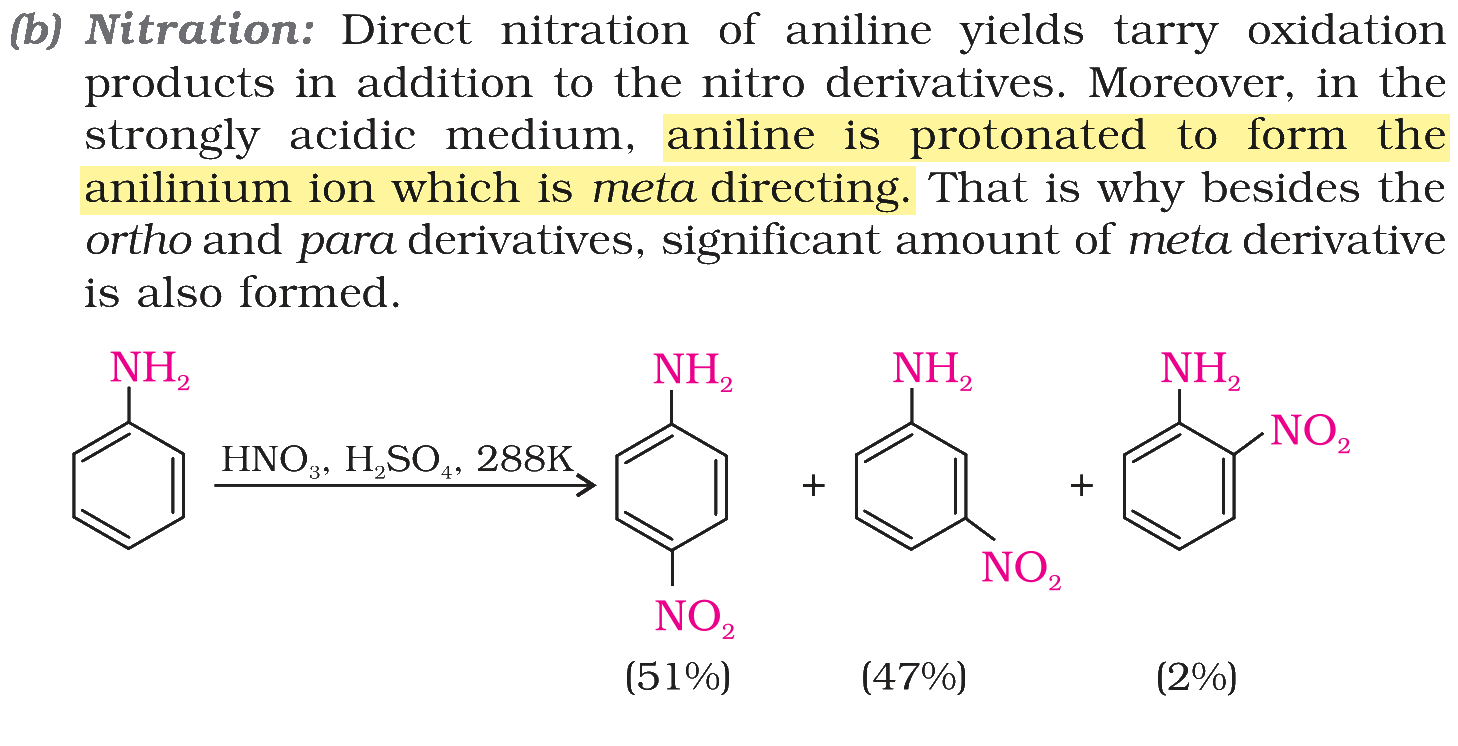
Predict the % of nitration products when aniline is subjected to nitration with Conc. \( HNO_3 \)/Conc. \( H_2SO_4 \).
Answer & explanation
Correct answer: option 2
The correct answer is Option (2) → o-nitroaniline 2%; m-nitroaniline 47%; p-nitroaniline 51%
The –\( \ce{NH2} \) group of aniline is a strongly activating ortho/para director. But nitration is carried out in a strongly acidic medium (conc. \( \ce{HNO3} \) + conc. \( \ce{H2SO4} \)), where most of the aniline is protonated to the anilinium ion:
\( \displaystyle \ce{C6H5NH2 + H+ <=> C6H5NH3+} \)
The \( \ce{-NH3+} \) group has no lone pair and withdraws electrons, so it is a meta director. Free aniline gives the para (and a little ortho) product, while the anilinium ion gives the meta product. The result is a mixture with a large share of the meta isomer; the ortho isomer is formed only in small amount:
\( \displaystyle \ce{C6H5NH2} \xrightarrow[\text{288 K}]{\text{conc. }\ce{HNO3},\ \text{conc. }\ce{H2SO4}} p\text{-nitroaniline}\,(51\%) + m\text{-nitroaniline}\,(47\%) + o\text{-nitroaniline}\,(2\%) \)
So the products are o-nitroaniline 2%, m-nitroaniline 47% and p-nitroaniline 51%. Direct nitration also gives tarry oxidation products, which is why the –\( \ce{NH2} \) group is usually protected by acetylation first.
NCERT (2026-27 edition):
Nitration