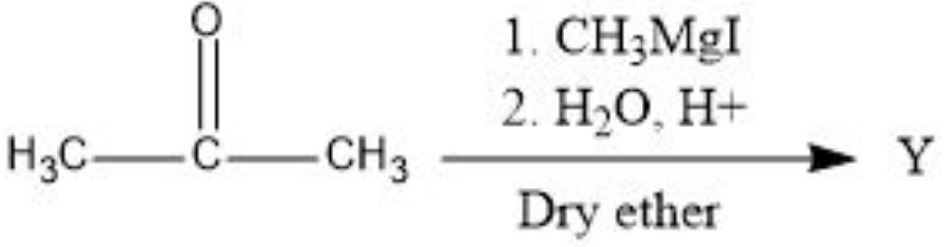
The product Y in the following reactions
Answer & explanation
Correct answer: option 4
The correct answer is Option (4) → 2-methylpropan-2-ol
A Grignard reagent RMgX has a highly polar C–Mg bond, so its carbon behaves as a carbanion. It adds to the carbonyl carbon of an aldehyde or ketone (nucleophilic addition) to give an adduct, which is hydrolysed by dilute acid to an alcohol. The carbonyl compound decides the class of alcohol: methanal gives a primary alcohol, other aldehydes give secondary alcohols and ketones give tertiary alcohols. The reaction is carried out in dry ether because water destroys the Grignard reagent.
Acetone (propanone) reacts with methylmagnesium iodide:
\( \displaystyle \ce{(CH3)2C=O + CH3MgI} \xrightarrow{\text{dry ether}} \ce{(CH3)3C-OMgI} \)
\( \displaystyle \ce{(CH3)3C-OMgI} \xrightarrow{\ce{H2O},\ \ce{H+}} \ce{(CH3)3C-OH + Mg(OH)I} \)
So Y is 2-methylpropan-2-ol (tert-butyl alcohol): the carbon of the C=O group now carries three methyl groups and the –OH group.
Why the other options are incorrect
Option (1) propan-2-ol — Incorrect. It is a secondary alcohol; it is formed from ethanal and \( \ce{CH3MgI} \), or by reducing acetone, not by adding a methyl group to acetone.
Option (2) propan-1-ol — Incorrect. It is a primary alcohol; it is formed from methanal and ethylmagnesium halide.
Option (3) ethanol — Incorrect. It is formed from methanal and \( \ce{CH3MgI} \); it has fewer carbon atoms than acetone itself.
NCERT (2026-27 edition):
From Grignard Reagents