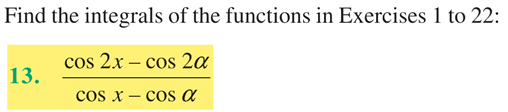
\(\int\displaystyle\frac{\cos 2x- \cos 2\alpha}{\cos x-\cos \alpha}dx\) is equal to
Answer & explanation
Correct answer: option 1
The correct answer is Option (1) → \(2 \sin x + 2x \cos \alpha +C\), where C is an arbitrary constant
Using \(\cos 2\theta = 2\cos^2\theta - 1\), the numerator becomes a difference of squares:
\(\cos 2x - \cos 2\alpha = 2\cos^2 x - 2\cos^2\alpha\)
\(= 2(\cos x - \cos\alpha)(\cos x + \cos\alpha)\)
Cancelling \(\cos x - \cos\alpha\):
\(\displaystyle \int \frac{\cos 2x - \cos 2\alpha}{\cos x - \cos\alpha}\,dx = \int 2(\cos x + \cos\alpha)\,dx\)
Here \(\cos\alpha\) is a constant, so its integral is \(x\cos\alpha\):
\(\displaystyle \int \frac{\cos 2x - \cos 2\alpha}{\cos x - \cos\alpha}\,dx = 2\sin x + 2x\cos\alpha + C\)
Why the other options are incorrect
Option (2) \(2 \sin x + 2 \sin \alpha +C\), where C is an arbitrary constant — Incorrect. The integral of the constant \(2\cos\alpha\) with respect to x is \(2x\cos\alpha\), not \(2\sin\alpha\); \(2\sin\alpha\) is itself a constant and would be absorbed into C.
Option (3) \(\frac{\sin 2x}{2}+x \cos 2\alpha + C\), where C is an arbitrary constant — Incorrect. Its derivative is \(\cos 2x + \cos 2\alpha\), which is not the integrand.
Option (4) \(\frac{\sin 2x}{2}+\frac{\sin 2\alpha}{2} + C\), where C is an arbitrary constant — Incorrect. Its derivative is \(\cos 2x\), which is not the integrand.
NCERT (2026-27 edition):
Integration Using Trigonometric Identities