The critical angle C for an air-water surface is shown in one of the following diagrams. Identify the correct diagram.
Answer & explanation
Correct answer: option 3
The correct answer is Option (3)
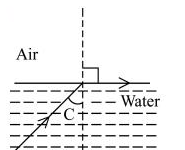
The critical angle is the angle of incidence, in the denser medium, for which the refracted ray grazes the surface (angle of refraction 90°). So the ray must travel in water towards the water-air surface, and C must be measured between that ray and the normal (the dashed line).
Only the diagram in Option (3) shows both: a ray rising through the water to the surface, with C marked between the ray and the normal.
Why the other options are incorrect
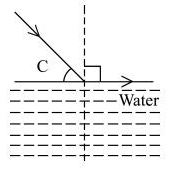
Option (1) — Incorrect. The ray travels in air towards water, and C is marked between the ray and the surface, not the normal.
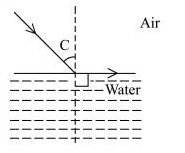
Option (2) — Incorrect. C is measured from the normal, but the ray is in air, the rarer medium. Total internal reflection and a critical angle do not exist for light going from air into water.
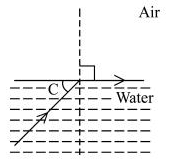
Option (4) — Incorrect. The ray is in water, but C is marked between the ray and the water surface instead of the normal.
NCERT (2026-27):
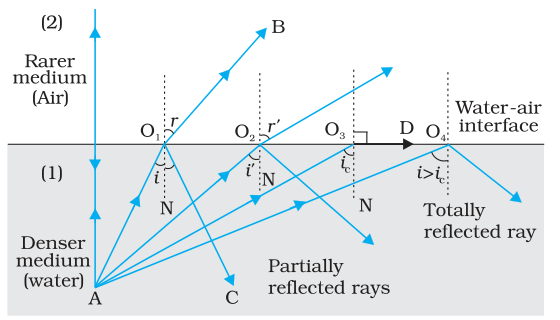
Total Internal Reflection – “When light travels from an optically denser medium to a rarer medium at the interface, it is partly reflected back into the same medium and partly refracted to the second medium. … The angle of incidence corresponding to an angle of refraction 90°, say ∠AO3N, is called the critical angle (ic) for the given pair of media.”