
CUETMOCK
  • Pricing
  • Mentors
Log inStart freeStart free mocks→

First test, then trust

Try a free CUET mock test.

Join 5,00,000+ students who rehearsed exam day on the exact NTA screen before sitting CUET. On the web and on Android.

Start free mocks →Get the Android app
CUETMOCK

India's #1 CUET Mock Test Platform. Original NCERT-based questions on the exact NTA exam screen — trusted by 5,00,000+ students since CUET 2022.

Get it onGoogle PlayScan to download the CUETMOCK app

Mock tests

  • CUET mock test series
  • Commerce mocks
  • Humanities (Arts) mocks
  • Science mocks
  • Languages & GAT mocks
  • Free practice questions
  • Pricing

Resources

  • CUET exam guide
  • CUET syllabus
  • Universities accepting CUET
  • Expert blogs
  • News & notifications
  • Webinars & counselling
  • CUET score calculator
  • How we estimate your rank
  • FAQs

Company

  • About us
  • Our leadership & team
  • Our toppers
  • Mentors
  • For schools
  • Contact us
  • Terms
  • Privacy
  • Refund policy

Talk to us

+91 7696 6630 56info@cuetmock.comWhatsApp us

Our other platforms

  • JEE Mock — For IIT-JEE aspirants
  • NEET Mock — For NEET aspirants

Newsletter

Exam updates, study material and offers — no spam.

© 2026 NYC Ventures Pvt. Ltd.

701-702, Royal Business Park, Zirakpur, Punjab - 140603

  • Terms of use
  • Privacy policy
  • Refund policy
  • Contact us

iCUETMOCK is an independent preparation platform, not affiliated with the National Testing Agency (NTA). Always check exam details on the official NTA website.

  • Home
  • Mock tests
  • CUET guide
  • Pricing
  • Log in
Home/Practice questions/Chemistry
ChemistryOrganic: Aldehydes, Ketones and Carboxylic Acids

Propanal is shaken with a saturated aqueous solution of sodium hydrog…

Propanal is shaken with a saturated aqueous solution of sodium hydrogensulphite. The addition compound formed is then warmed with dilute hydrochloric acid. What is obtained in the second step?

Answer & explanation+

Correct answer: option 2

The correct answer is Option (2) → Propanal

Step 1 – Addition of NaHSO3: sodium hydrogensulphite adds to the carbonyl group of propanal by nucleophilic addition. The addition is reversible, and for most aldehydes the equilibrium lies well to the right. The crystalline addition compound carries an OH group and an –OSO2Na group on the former carbonyl carbon (scheme below the extract):

    \( \displaystyle \ce{CH3CH2CHO + NaHSO3 <=> CH3CH2CH(OH)OSO2Na} \)

Step 2 – Warming with dilute acid: warming the addition compound with dilute mineral acid breaks it down and gives back the original aldehyde:

    \( \displaystyle \ce{CH3CH2CH(OH)OSO2Na + HCl} \xrightarrow{\Delta} \ce{CH3CH2CHO + NaCl + SO2 + H2O} \)

Final product: the original aldehyde, propanal (Option 2). The addition compound is water soluble, so it can be taken away from other substances and then turned back into the aldehyde. This is why the reaction is used to separate and purify aldehydes.

Why the other options are incorrect

Option (1) Propan-1-ol — Incorrect. Propan-1-ol is the reduction product of propanal, formed with NaBH4 or LiAlH4:

    \( \displaystyle \ce{CH3CH2CHO} \xrightarrow{\ce{NaBH4}} \ce{CH3CH2CH2OH} \)

Option (3) Propanoic acid — Incorrect. Propanoic acid needs an oxidising agent, such as Tollens’ reagent or acidified potassium dichromate. Dilute HCl does not oxidise the aldehyde.

Option (4) 2-Hydroxybutanoic acid — Incorrect. This forms when propanal adds HCN and the cyanohydrin is then hydrolysed; the extra carbon comes from the cyanide group:

    \( \displaystyle \ce{CH3CH2CHO} \xrightarrow{\ce{HCN}} \ce{CH3CH2CH(OH)CN} \xrightarrow{\ce{H3O^+}} \ce{CH3CH2CH(OH)COOH} \)

NCERT (2026-27 edition):
8.4 Chemical Reactions – “The position of the equilibrium lies largely to the right hand side for most aldehydes and to the left for most ketones due to steric reasons. The hydrogensulphite addition compound is water soluble and can be converted back to the original carbonyl compound by treating it with dilute mineral acid or alkali. Therefore, these are useful for separation and purification of aldehydes.”
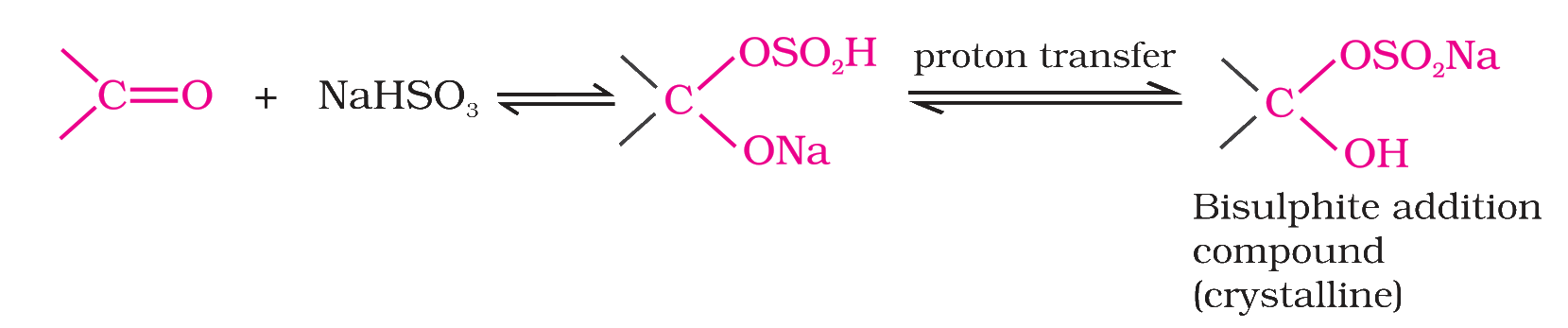
Addition of sodium hydrogensulphite

Advertisement

Practise more on Organic: Aldehydes, Ketones and Carboxylic Acids

Chapter-wise mocks on the real NTA exam screen, with solutions and your rank. Your first mocks are free.

Start free mocks →

Advertisement

Next questions

  1. The government is trying to sell its share in several public sector companies, a process which is known as:Sociology · Social Change and Development in India: Change and Development in industrial Society
  2. Which statement is correct about Shyama Prasad Mukherjee's final days?Political Science · Politics in India Since Independence: Era of one Party Dominance
  3. Which one of the following diseases is not the sexually transmitted infection?Biology · Reproductive Health
  4. Ashutosh can complete an assignment in 14 hrs and Siya can do it in 10 hrs. Together with Rahul , they completed the work in 5 hrs. Then, h…General Aptitude Test · Numerical Ability
  5. Which type of organisation clearly specifies the boundaries of authority and responsibility and ensures systematic coordination among the v…Business Studies · Organising
  6. Choose a product made in the cottage industry from the given options:Geography · Fundamentals of Human Geography: Secondary Activities
  7. A, B and C were partners in a firm sharing profits in the ratio of 5:3:2. On March 31, 2025 the balance sheet of the firm shows the capital…Accountancy Part A · Reconstitution of Partnership Firm: Retirement and Death
  8. Which statement about the sculpture "Cries Unheard" by Amarnath Sahgal is incorrect?Fine Arts · The Modern Indian Art
  9. Arrange the groups of towns chronologically based on their evolution from ancient to modern. (A) Delhi, Hyderabad, Jaipur.(B) Harappa, Moha…Geography · India-People and Economy: Human Settlements
  10. From the following information, calculate inventory Turnover Ratio : PARTICULARS AMOUNT (₹) Inventory in the beginning 18,000 Inventory at…Accountancy Part B · Accounting Ratios